``Al-Qaeda is on their heels but not defeated,'' McCain said today at a town hall meeting with General Motors workers in Warren, Michigan. ``I also predict that they will make an attempt, as we get into election season, to make more of these spectacular kinds of attacks'' by suicide bombers to destabilize the government of Iraqi Prime Minister Nuri al-Maliki.
McCain, an Arizona senator, has spent much of this week touting his foreign policy and war experience while Democratic rival Barack Obama prepared for a trip to the Middle East. McCain has criticized Obama, an Illinois senator, for vowing to withdraw troops from Iraq within 16 months of taking office. McCain said the deployment of extra U.S. troops to Iraq last year has worked.
Earlier this year, McCain adviser Charlie Black caused a controversy when he was quoted in a Fortune magazine interview that the assassination of former Pakistani Prime Minister Benazir Bhutto before the New Hampshire primary ``helped us'' by highlighting that McCain ``is the guy who's ready to be commander in chief.'' Black added that a ``fresh terrorist attack certainly would be a big advantage'' politically.
Black later said he ``deeply'' regretted making the statement and McCain distanced himself from the comments.
``Senator Obama said the surge would fail. He still fails to admit that it has succeeded,'' McCain said in response to a question from the audience. ``I am confident we will win.''
Friday
Bloomberg Reports McCain Predicts Terrorist Attacks & Political Cartoon of the Day


Wednesday
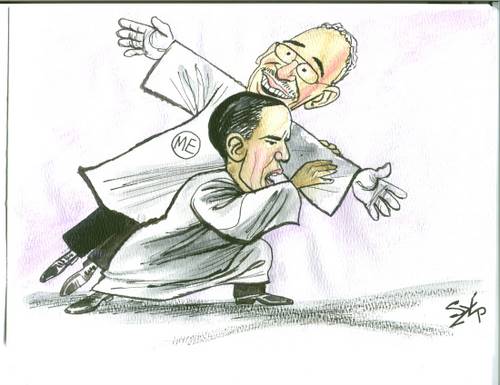
Ok so the Political Cartoon of the day really doesn't have much to do with the election this year a whole lot, but todays article does deal with foreign policy and this political cartoon really does deal with foreign policy. This cartoon also was just a unique find for me since it is kind of old and quite witty. You could take this political cartoon and replace the swastica with a particular garment and suddenly it would become quite relevant but we wont discuss that too much. So lets just get on to the real foreign policy relevant to the modern world instead of an old political cartoon.
The Illinois senator has over the past two days escalated a campaign to minimize Iraq in the context of the overall war on terror.
Obama on Wednesday stressed the need to secure loose nuclear material and draw down nuclear stockpiles around the world. He said if the nation devoted just one month of Iraq combat costs, estimated to be $10 billion, it could virtually wipe out the threat of weapons-grade nuclear material falling into the hands of terrorists.
In what was billed as a major foreign policy address Tuesday, Obama said the Iraq war has become a distraction from fighting terrorism in Afghanistan and pledged to end the war by the summer of 2010.
Barack Obama’s continued call for a troop withdrawal timetable in Iraq has critics complaining that he’s set on that policy before even taking his highly anticipated trip to the Middle East.
“He’s going to Iraq but he’s already decided his position,” Connecticut Sen. Joe Lieberman, a top John McCain supporter, told FOX News on Wednesday. “He’s not going to listen to (David) Petraeus. He’s not going to listen to our troops. He’s not going to listen to his own eyes with what he sees there.”
The McCain campaign seized on an editorial Wednesday in The Washington Post that criticized Obama for sticking with his 16-month troop withdrawal timeline, even after hinting that he would “refine” his policy after visiting Iraq and Afghanistan.
“Mr. Obama appears to have decided that sticking to his arbitrary, 16-month timeline is more important than adjusting to the dramatic changes in Iraq,” the editorial said. “American commanders will probably tell Mr. Obama that from a logistical standpoint, a 16-month withdrawal timetable will be difficult, if not impossible, to fulfill. … If Mr. Obama really intends to listen to such advisers, why would he lock in his position in advance?”
McCain adviser Randy Scheunemann said on a conference call that Obama’s plan is an “ideologically driven commitment to withdrawing at any cost.”
“The American people have had enough of inflexibility on national security policy,” he said, obliquely criticizing the Bush administration.
McCain spokesman Tucker Bounds said in a statement that Obama was also “committing to a policy” for Afghanistan before even visiting the country, and that “Barack Obama has shown he views foreign policy through a lens of ideology rather than through looking at facts.”
The Obama campaign argues that McCain is just now “waking up” to problems in Afghanistan, and claims he has no workable plan for either conflict.
Obama foreign policy adviser Susan Rice said on a conference call that McCain “wants to stay indefinitely at high-troop levels in Iraq, regardless of the situation, whether it’s improving or deteriorating.”
Obama released a new ad Wednesday addressing his national security platform.
“Forty years ago it was missile silos and the Cold War. Today, it’s cyber attacks, loose nukes, oil money funding terrorism,” the narrator in the ad says. “Barack Obama understands our changing world.”
As for the Washington Post editorial, she said it represented a narrow-minded approach to a broad set of national security threats.
“The Post would have you believe that we have the luxury of worrying only about one challenge and, whether it’s going well or going poorly, the answer is the same: to stay indefinitely,” she said.
“But we have a fundamental difference on the threat environment that we face globally.”

Obama and McCain: The effect of economy on Polls & Todays Political Cartoon

With four months to go until Election Day, the outcome is set in stone, barring some sort of miracle, some experts say.
That's the view of the overwhelming majority of social scientists who make it their business to peer into the future.
The poor state of the economy, the casualties in Iraq, the unpopularity of George W. Bush, the current polling, and Obama's own political skills all point to the election of the Illinois Democrat in November, according to several political scientists, historians and economists who've had a pretty good track record in predicting past elections.
According to their models, it won't be close. Most of them are projecting a 52% to 48% victory for Obama, and that's with assumptions about the economy that are very kind to McCain.
Political scientists noted long ago that presidential elections are fairly predictable because they usually turn on several big issues: How's the economy doing? Is there an unpopular war? Has one party outlived its welcome at 1600 Pennsylvania Avenue? Is one of the candidates a once-in-a-generation leader? Has the current administration done anything outstanding, or scandalous?
Of course, all these models assume that this year's campaign will be pretty much like those in the past. A major gaffe or stumble by Obama, or superb campaign by McCain could change the dynamics. So could outside events that alter the election landscape.
There's a whole cottage industry of experts who develop statistical models based on past elections and crunch the numbers to try to predict November's vote now. Almost all of the models say Obama will win.
The granddaddy of the prediction models is American University historian Allan Lichtman's 13 keys to the White House, which include factors such as the economy, foreign policy, scandals, social unrest and even the charisma of the candidates. No one's been elected president since 1860 without holding most of the keys to victory.
Economist Douglas Hibbs expanded on Fair's idea by including a war variable, which hurts the incumbent party if there are significant casualties in an undeclared war. Hibbs' "Bread and Peace" model explains Eisenhower's victory in 1952 and Nixon's win in 1968. The unpopular war could also be a factor in 2008, but the weak economy is a much bigger reason why the Republicans are likely to get just 48% of the votes this year.
"Support for the two major parties has solidified as the parties and their supporters have become increasingly divided along ideological lines," Abramowitz said. "Growing polarization may weaken the effects of short-term forces such as the economy and presidential approval." The approval rating of the president is one of three variables in Abramowitz's model.
Political scientist Alan Abramowitz of Emory University says his "Time for a Change" model is forecasting a Democratic landslide of about 54% to 46%. But Abramowitz doesn't think it'll be that much of a blowout because there are fewer true independents these days.



Saturday
Obama Polls: Election 08 Obama v McCain
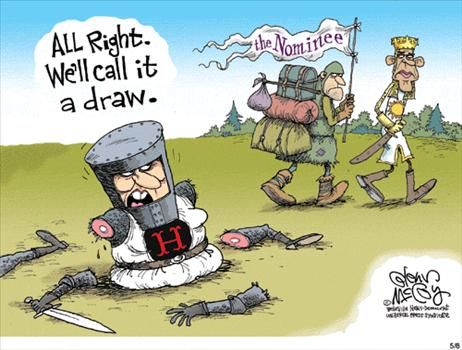
For the Political Cartoon of the Day I think it appropriate to go with the following cartoon which deals with the concept of electronic voting in the upcoming election. After today I am going to start dealing with some of the issues surrounding the election itself instead of just the candidates. I think this political cartoon shows what is at the heart of the election but by the voting population is not paid really any attention. Soon I will get back discussing the politicians and their ideals and ideas but for now I will just discuss the current issue of polls surrounding the candidates and how we are getting a little carried away and then the Electronic Voting Issues for a few Days. I will also be doing a post or two of just some funny and interesting Political Cartoons and Videos of the 2008 Elections. Today though we are just going to deal with the overwhelming number of polls and what exactly to they really mean?

“It’s increasingly clear from our ‘poll of polls’ average that Sen. Obama holds a small advantage over Sen. McCain as we head into the general election,” says CNN Senior Political Researcher Alan Silverleib. “Time will tell whether Obama's lead is a temporary bounce resulting from the end of the Democratic nomination fight, or whether it is a more permanent reflection of voters’ desire for change this year.”
The latest edition of the CNN Poll of Polls is an average of four new national surveys, a Gallup poll taken from June 9-12, an NBC/Wall Street Journal survey conducted from June 6-9, a Diageo/Hotline poll taken from June 5-8, and our own CNN/Opinion Research Corporation survey conducted from June 4-5. The CNN Poll of Polls does not have a sampling error. Which in my opinion is kind of hard to understand considering my stats background.
Presumptive Democratic nominee Obama holds a six point lead over his Republican counterpart McCain a new CBS News poll finds. Obama leads McCain 48 percent to 42 percent among registered voters, with 6 percent of respondents undecided.
The poll contains troubling signs for Obama as he looks to mobilize the Democratic Party behind him following his long and sometimes bitter battle with Hillary Clinton for the Democratic nomination, however.
So what polls are to be trusted? We know that with the White Male vote McCaine leads Obama by double digits and is also ahead of Obama in the Suburban Moms demographic while Obama leads in the Lation, Young Voters, and overall Women Demographic. All of this information leads to inconclusive evidence seemingly pointing us to the conclusion that as of yet we have not decided what we want as a country. We also know that 68% of all previous Clinton voters are saying they will vote Obama in the upcoming election while nearly 10 % are undecided and the rest say they will vote for McCain.
Twelve percent of Democrats say they will support McCain in the general election. That's higher than the 8 percent of Democrats who defected to President Bush in 2004. Nearly a quarter of Clinton supporters say they will back McCain instead of Obama in the general election.
McCain leads Obama by 8 points among registered independent voters, considered a key voting block in November. The Arizona senator leads Obama 46 percent to 38 percent, with 11 percent of respondents undecided.
And overall we know that the margin of error in a complete poll still overlaps leading to a direct tie between the two candidates in terms of the upcoming election. This year seems to show though that we are beginning to try a predict a little too much when we really don't have the information necessary to make any kind of informed decision, we still have not heard the two in a head to head debate with a widely publicized and distribution model and we still do not know at what point the two candidates are going to pick their running mates. Although many voters feel that the running mate does not bear too much weight on their decision for president I think that this year we could see a large change in that viewpoint if Obama were to pick Hillary as a running mate or McCain to pick another female as well. I also think it is quite plausible that McCain could pick somebody from the state of Alaska as his running mate for reasons of shared interest with the Bush Administration in terms of drilling, ecspecially with the rising price of gasoline in this country.
Friday
Clinton caught in Lie about Sniper in Bosnia and Political Cartoon of the Day

Dilating on her extensive experience of foreign affairs, the New York senator told a campaign event last week that she vividly remembered how, with the Balkans still a cauldron of war, she had flown into an airfield under sniper fire. She had had to dash, head-down from the aircraft, she told the spellbound audience, to the safety of waiting cars, and the planned traditional arrival ceremony had been hastily canceled in the mêlée.
It sounded thrilling - like something out of a Tom Clancy novel. The problem was, it probably did come out of a Tom Clancy novel. It was pure fiction.
A good memory is needed once we have lied,” observed Pierre Corneille, the 17th-century French tragedian. He was right. The complexities involved in keeping an untruth plausible and consistent are so tortuous that to be really good at lying demands exceptional recall of what was said when and where.
But Corneille was writing before the age of YouTube. Nowadays, no amount of familiarity with memory's labyrinth will save you when there is downloadable disproof at the click of a mouse button. So Hillary Clinton discovered this week, when she was caught out in a prize fib about a trip she made to Bosnia when she was First Lady 12 years ago.
CBS unearthed some news video of the arrival ceremony and it was promptly disseminated on YouTube. There was Mrs Clinton, serene and smiling, strolling with her entourage from the plane, head held high, and in no evident danger from snipers, terrorists, or even the odd slightly miffed Serb. Seconds later she was being greeted in what looked very much like a traditional arrival ceremony on the tarmac where a small girl embraced her and the two chatted warmly for a while. I've been in more physical danger coming out of the car park at Heathrow.
Confronted with the incontrovertible evidence Mrs Clinton acknowledged this week that she “misspoke”. Misspeak is an Orwellian term deployed by politicians to describe what has happened when they have been caught in a barefaced lie.
The Clintons have a well-formed habit of misspeaking. Bill Clinton, of course, was always doing it. But his wife has also over the years mastered the art of misspeaking in what Mark Twain once described as an “experienced, industrious, ambitious and often quite picturesque” way.
She has misspoken on any number of occasions when the straight truth might have been very damaging: over her involvement in the various scandals of the early Clinton years. But alongside these instrumental whoppers, there have been some befuddlingly pointless little tiddlers too.
When she ran for New York senator she claimed to have been a lifelong fan of the New York Yankees even though no one could recall her ever having expressed the slightest interest in or knowledge of the baseball team.
For no obvious reason she once claimed her parents named her after Sir Edmund Hillary, even though she was born more than five years before the mountaineer's ascent of Everest, when he was known by almost no one outside New Zealand.
In fact the facility with which the Clintons misspeak is so pronounced that it is quite possible they have genuinely forgotten how to tell the plain truth. There was no real need for Mrs Clinton to make the claim about landing in sniper fire. But the compulsion to embroider, to dissemble and to dissimulate is now so entrenched in the synapses of the Clinton brain that it came to her as naturally as the truth would to a slow-witted innocent.
Someone once noted that the thing about the Clintons is that they will choose a big lie when a small lie will do, and choose a small lie when the truth will do. Most of the time they get away with it. But occasionally, an inconvenient truth, like a blue dress with DNA on it, or some forgotten news footage, shows up and damns them.
With this latest deceit stripped away, there is not much left to Mrs Clinton's disintegrating campaign for the Democratic nomination. It capped a bad week for her, a week that might have signalled the end of her hopes.
With a deft speech that was somewhat lacking in complete honesty itself, Barack Obama last week seemed to have acquitted himself quite well, for now, of the charge of being an associate of a ranting, anti-American black preacher. More important, the collapse last week of efforts to schedule a new vote in Florida and Michigan, two states whose earlier primary votes have been disqualified, was deadly to Mrs Clinton. It is now virtually impossible for her to finish ahead of Mr Obama in the delegate count when the primary season ends in early June.
That really ought to be that. After that final primary in Puerto Rico on June 1, Mr Obama will have won more states, more delegates and more popular votes than Mrs Clinton. How in those circumstances can Mrs Clinton claim a moral case for staying in the race?
Her answer is to persuade the party's super-delegates - top party leaders and elected officials who will have the casting votes - that she is more electable than Mr Obama, and that they would be doing the party a favour if they chose her over the wishes of the tens of millions of people who have voted in the primaries.
They are unlikely to be taken in. They are more likely to view it as another example of Senator Clinton's misspeaking. forgot bosnia forgot bosnia forgot bosnia forgot bosnia lie sniper lie sniper lie sniper lie
The Bosnia misspeak, unnecessary as it was, revealed much, however. It helped to expose a much bigger untruth Mrs Clinton has been peddling throughout the Democratic primary campaign - that her time in the White House means she has the necessary foreign policy experience to be president. forgot bosnia forgot bosnia forgot bosnia forgot bosnia lie sniper lie sniper lie sniper lie
First Ladies don't acquire real foreign policy experience. We know that Mrs Clinton did not, as she claimed, play a large role in the Northern Ireland peace process, that she was not, as she claimed, a key voice in counsels on the Balkans, and that she did not even have security clearance in the White House for the most sensitive of conversations about national security.
So the problem with the ripping yarn about the Bosnia snipers is that it offers hard evidentiary disproof of improbable claims about her role during the White House years.
forgot bosnia forgot bosnia forgot bosnia forgot bosnia lie sniper lie sniper lie sniper lie political cartoon is something we need to laugh at, because a political cartoon is funny as hell. Who doesn't like a political cartoon because political cartoon s are what makes things easier for us to deal with politically. The political cartoon is also a nice reminder of current events and a political cartoon makes certain topics relavent to people who would normally not pay attention
Reverend Wright, Barack Obama, and the Political Cartoon of the Day

With Racism playing a newly found large role in this years election we are not only seeing the Clinton campaign as the perpetrator of the racist remarks. As Hillary Clinton as had to denounce previous statements made by members in her campaign, Barack Obama has had to deal witht the words of a previous pastor of his Reverend Wright. Rev. Wright had baptized Obama and has had a solid relationship with him for years. The problems is the views of Wright on many social issues and the most recent statements regarding being black in the United states and the concept that Hillary Clinton has no idea about the racism that exudes from many in this country. Below is a video, taken from the self admitted HORRENDOUS news network Fox News, where we can see Wright's comments regarding Clinton and race.
It will be interesting to see how this will affect the current climate in the Obama campaign and to see just how Obama will react. In other news we have Obama dealing with Jewish Concerns.
Here is the Times’ front-page profile of Obama’s mother. It’s a fascinating read. “Though it is impossible to pinpoint the imprint of a parent on the life of a grown child, people who knew Ms. Soetoro well say they see her influence unmistakably in Mr. Obama.”
Obama didn't appreciate the Wayne Allard stunt that called for appropriating every Obama presidential proposal. Apparently Schumer called Allard an a**, though Allard said the amendment wasn't his idea. Obama apparently asked Allard, "You working this hard," Allard shot back: "Vote yes." Allard, by the way, didn't vote for his own amendment.
Obama continues to make efforts to allay Jewish concerns. "Barack Obama has a solid Senate record in support of Israel… Yet there is unease among some Jewish voters about the Illinois senator and Democratic presidential contender. Why? Part of it is a division between blacks and Jews that's been growing for years, a split that Obama has challenged fellow blacks to confront. Another element is the praise Obama has received from Black Muslim leader Louis Farrakhan, whose disparaging comments about Judaism are toxic to many voters. Obama's own pastor has a history of supporting Palestinian causes."
“Finally, there are rumors and outright lies about the candidate that have gained an audience through repetition in e-mails and on Web sites. Obama is working hard to win over this vocal, powerful and reliably Democratic voting bloc. Jews have accounted for about 4 percent of Democratic primary voters so far this year, and Clinton has held a 52-46 percent edge over Obama among them, according to exit polls.”
“On the day of the Mississippi primary this week, Obama took time to call Israeli Foreign Minister Tzipi Livni to express condolences over the deadly terrorist attack on a rabbinical seminary in Jerusalem. He also reaffirmed his support for Israel's right to defend itself and for its commitment to negotiations with Palestinians and underscored the need to stop Iran from supporting terrorism or getting nuclear weapons. The effort by the candidate and his advisers to calm disquiet among Jewish voters began more than a year ago."
Where do Jews go if Obama is the nominee? How big of a problem is this for him? Does it put Florida in jeopardy if enough older Jewish voters end up going for McCain?
The New York Post looks at the comments made by Obama’s former pastor, Jeremiah Wright, “who stepped down from his post after 36 years, preaches a form of black liberation theology, stressing ties to Africa and ways to empower Chicago's struggling black community.”
Wednesday
Ferraro Says comment wasn't racist and Political Cartoon of the Day

"My comments have been taken so out of context and been spun by the Obama campaign as racist," she said on ABC's "This Morning America." "That, you know is doing precisely what they don't want done -- it's going to [divide] the Democratic Party and dividing us even more."
Geraldine Ferraro, a onetime Democratic vice presidential nominee and current Clinton fundraiser, continued to insist today that she is being unfairly criticized for comments on Barack Obama that implied the Illinois senator has done well in the presidential race because he is black.
Ferraro, the first woman to be on the ticket as a vice presidential candidate in either party, ignited a controversy when she told the Daily Breeze of Torrance that: "If Obama was a white man, he would not be in this position. And if he was a woman [of any color] he would not be in this position. He happens to be very lucky to be who he is. And the country is caught up in the concept."
Ferraro, a former congresswoman from New York, said she was "hurt, absolutely hurt by how they have taken this thing and spun it to sort of imply in any way, in any way, I am a racist." But she said she was "absolutely not" sorry she had said Obama was benefiting from his status as the first African American perceived as having the chance to win the presidency.
"I was talking about historic candidacies," she said. "In 1984, if my name were Gerard Ferraro instead of Geraldine Ferraro, I would never have been chosen as the vice president."
But Obama, interviewed on NBC's "Today," said Ferraro's comments are absurd on their face.
"If you were to get a handbook on what's the path to the presidency, I don't think that the handbook would start by saying, 'Be an African American named Barack Obama.' I don't think that would be generally considered an advantage, and it certainly wasn't when I was running for the United States Senate or the presidency."
Saying that he respects Ferraro as "a trailblazer," Obama accused her of participating in "the kind of slice-and-dice politics that's about race and about gender and about this and that, and that's what Americans are tired of because they recognize that when we divide ourselves in that way, we can't solve problems."
On Tuesday, Clinton distanced herself from the remarks, but said intemperate remarks are a problem on both sides. Obama expressed distaste.
In a brief Associated Press interview Tuesday while she campaigned in Harrisburg, Pa., Clinton said she did not agree with Ferraro. She added, "It's regrettable that any of our supporters -- on both sides, because we both have this experience -- say things that kind of veer off into the personal."
Obama, in an interview with the Morning Call of Allentown, Pa., said, "I don't think Geraldine Ferraro's comments have any place in our politics or in the Democratic Party. They are divisive. I think anybody who understands the history of this country knows they are patently absurd. And I would expect that the same way those comments don't have a place in my campaign they shouldn't have a place in Sen. Senator Clinton's either."
But Ferraro, who ran on on Walter F. Mondale's losing ticket in 1984, dug in her heels.
"I'm sorry that people thought it was racist," Ferraro told Fox News on Tuesday. She said she was not acting as a Clinton representative, but was promoting a speech she had been paid to make, and resented the implication that she vets what she says with anyone.
"She can't rein me in," said Ferraro, referring to Clinton.
Later, in a statement that was e-mailed to reporters, Clinton's campaign manager, Maggie Williams, echoed Clinton. Her statement began with an Obama quote made in January while he was speaking to NBC's Tim Russert: "I think that, as Hillary said, our supporters, our staff, get overzealous."
"We agreed then," wrote Williams. "We agree today. Supporters from both campaigns will get overzealous."
Last week, one of Obama's unpaid foreign policy advisors, Harvard professor Samantha Power, resigned from his campaign after calling Clinton a "monster" in an interview with a Scottish newspaper. She apologized and blamed fatigue.
Ferraro, for her part, told Fox News that "if it makes David [Axelrod] happy, I would get off the [Clinton] finance committee."
But, she added, referring to Axelrod, "He shouldn't really antagonize people like me." If Obama is nominated, Axelrod "is going to come to me and ask me to raise money for Barack Obama, and I will do it for him, too, if he stops doing this kind of horrendous attack."
Alluding to Power in a conference call Tuesday with reporters, Obama's chief strategist, David Axelrod, said: "Ferraro should be denounced and censured by the campaign. Samantha resigned because it was not consistent with the kind of campaign we want to run. We want a candidate and president who will live by their words."
Monday
Clinton with Obama as Running Mate and Politcal Cartoon of the Day

Campaigning in Mississippi over the weekend, the former president was quoted as saying his wife and Obama could form "an almost unstoppable force."
After winning the Democratic primaries in Ohio, Texas, and Rhode Island last week, Senator Clinton suggested that she and Obama might end up on the same ticket, with her at the top of it.
Hillary and Bill Clinton have been talking up the idea that Barack Obama, whom they have called too inexperienced to be president, would make a strong running mate on a ticket headed by the New York senator.
Obama won the Wyoming caucuses Saturday, and the latest polls show him leading in tomorrow's primary in Mississippi. He is ahead of Clinton in pledged delegates, but neither candidate is expected to obtain the 2,025 needed for the nomination in the remaining state contests.
As of last night, Obama had 1,578 delegates and Clinton had 1,468. Democratic leaders worry about the damage that could be done if neither Clinton nor Obama has a clear lead by the August nominating convention.
In hailing Obama as a possible vice president, the Clintons are reaching out to him and, perhaps more important, to his backers, whose support she would need to defeat John McCain in the November election.
"The Clintons are in a difficult position," said Dennis Goldford, a political science professor at Drake University in Iowa, who has tracked the presidential race.
"If she wins the Democratic presidential nomination, she would need Obama's supporters. But she needs to be careful. If this talk of him on the ticket is seen as a cynical maneuver, it could backfire and hurt her," Goldford said.
The Clintons have charged that the charismatic senator from Illinois lacks the experience to handle an international crisis as president. But since Clinton won the Ohio and Texas primaries, she and her husband have repeatedly touted Obama as a possible running mate.
When asked about the possibility last week, Obama said he was focused on winning the nomination.
"I think it is very premature to start talking about a joint ticket," he said.
Senator John F. Kerry of Massachusetts, who has endorsed Obama, derided the Clintons' suggestion.
"The first threshold question about a vice president is, are you prepared to be president?" Kerry said yesterday on CBS's "Face the Nation."
"So on the one end, they are saying he's not prepared to be president. On the other hand, they're saying maybe he ought to be vice president," Kerry said.
Former Senate Democratic leader Tom Daschle of South Dakota also mocked the idea.
"It may be the first time in history that the person who is running number two would offer the person running number one the number two position," Daschle said on NBC's "Meet the Press."Governor Edward Rendell of Pennsylvania, a Democrat who has sought to rally support for Clinton in his state's April 22 primary, backed the idea of Clinton and Obama teaming up.
Pennsylvania, the biggest remaining state in the race for the nomination, should be a safe win for Clinton, but analysts say there are pockets of vulnerability for Obama to exploit - and plenty of time to do it.
"If the election were held today it would probably be Senator Clinton by 10 points, but seven weeks in this crazy race, anything can happen," said Clay Richards, assistant director of the Quinnipiac University Polling Institute.
A win in Pennsylvania could be crucial to Clinton's hopes of gaining support from "superdelegates" - elected officials and party insiders who can vote at the convention as they choose.
Mark Nevins, communications director for Clinton's campaign in Pennsylvania, said the state was "a proving ground."
"You can't really expect to win the general election if you can't win Pennsylvania," he said.
"Pennsylvania has more Catholics, more union members, more older voters, and fewer African-Americans," said Terry Madonna, politics professor at Franklin & Marshall College. "This is pretty much a Clinton state. It's hers to lose."
The demographics are similar to those of Ohio, which Clinton won by 54 percent to 44 percent. Madonna said Clinton also can play the "hometown" card because her father was born in Scranton.
Clinton will focus on healthcare and the economy to target the large population of seniors and union members, which is higher than the national average, Nevins said.
Richards of Quinnipiac said Obama must do three things to have a chance of winning: boost turnout among black voters, which is historically low in primaries; motivate students at the state's numerous universities and colleges; and win over affluent voters in the Philadelphia suburbs where Clinton is vulnerable.Sean Smith, a spokesman for Obama, contends that the demographics claimed as friendly by the Clinton campaign had helped Obama win Wisconsin and could do so again.
"We did extremely well in Wisconsin with the same types of voters," he said, pointing to older voters who were "absolutely open" to Obama's message of hope and change and "bringing the country together to solve our problems."
Saturday
News on Obama & Clinton in Wyoming and Today's Political Cartoon
Well Todays Political Cartoon is dealing with the current market trends and the concept of our Spending habits. I mean this cartoon doesn't even touch the fact that we are going to borrow the money for our next set of tax rebates from China. Hmmmm...Does that even make sense? Well This cartoon is at least funny. Now onto the real news.
With 96 percent of the precincts reporting, Obama had 59 percent to Clinton's 40 percent.

Democrats in Wyoming get little respect. The sparsely populated red state is home to just 218,000 thousand voters, most of them Republicans, like Wyoming's own Dick Cheney.
But this year, Clinton and Obama eagerly glad-handed voters across the state because even Wyoming -- with its 12 delegates -- counts.
Barack Obama won the Democratic caucuses today in Wyoming, a state the party's presidential candidates often overlook, but that in this nail-biter of a race saw heavy campaigning by both Obama and Hillary Clinton.The excitement about the Democratic race was evident at the Teton County Caucus, held in Jackson. Originally scheduled for the Virginian motel, the caucus had to be moved to the larger Snow King Resort to accommodate the crowds that turned out.
In previous years, no more than 200 Democrats had ever turned out in Teton County, but this year Democratic State Committee chairwoman Lesley Peterson estimated the overflow crowd at 1000 or more by early evening.
The high turnout among Wyoming Democrats is more evidence of how tight the race is between Clinton and Obama nationwide.
A Newsweek poll released Friday found the rival candidates for the Democratic presidential nomination in a statistical dead heat, with 45 percent of registered Democrats and Democratic leanings favoring Obama, and 44 percent favoring Clinton.
That marks the latest pendulum swing in a race that last year saw Clinton as the all-but-inevitable Democratic candidate, to Obama's decisive lead during a sweep of February primary states. The poll was based on telephone interviews with 1,215 registered voters March 5-6.
The Newsweek poll also shows neither candidate has an edge when it comes to voters' number-one concern: The foundering economy, with 43 percent favoring Obama, 42 percent preferring Clinton.
The poll does show that seven in 10 Democrats want that dream team: Obama-Clinton or Clinton-Obama.
Today, former president Bill Clinton for the first time sent a clear signal that the Clinton campaign has given serious consideration to that dream ticket too, combining Obama's urban appeal and Clinton's rural appeal.
"You look at the map of Texas and the map in Ohio, and the map in Missouri," Clinton said during a campaign stop on his wife's behalf in Mississippi, "You look at most of these places -- he would win the urban areas and the upscale voters, and she wins the traditional rural areas that we lost when President Reagan was president. If you put those two things together, you'd have an almost unstoppable force."
Obama said Friday he's not interested in holding the No. 2 slot on a Democratic dream team.
"You won't see me as a vice presidential candidate," Obama said in a radio interview.
Despite talk of a dream team, the bitter tone of the campaign for the White House is likely to get worse, with Clinton on the offensive and Obama walking a fine line, talking tough while trying to remain above the mudslinging.
Iowa Republican Rep. Steve King gave a taste of what could lie ahead.
In an interview with KICD radio in Spencer, Iowa, the congressman virtually called him a terrorist ally.
"If he is elected president, then the radical Islamists, the al Qaeda, the radical Islamists and their supporters will be dancing in the streets," King said. "They will be dancing in the streets because of his middle name."
If he does win the nomination, Obama will have to respond to Republicans, and to his conservative critics who pointedly refer to him using his full name, Barack Hussein Obama.
Tuesday
Obama looking for the Knockout Punch and Political Cartoon of the Day
On the momentum side, however, if Clinton wins both states, even narrowly, she could blunt Obama's momentum and generate some of her own. Headlines will declare a Clinton victory in two giant states, lifting some of the pressure on her from party leaders to exit the race. Obama's best chance for a knockout blow is Texas, where polls have given him a slight edge. "Obama, to stop her, really has to win one of the two big states. Then the delegate math does take over," said Tad Devine, a top strategist for the Al Gore and John Kerry presidential campaigns. But if Clinton wins both, she is likely to stay in the race. "Even if the math works in Obama's favor, if he loses two big states, I don't think that's how you win the nomination," Devine said. "You don't win the nomination by losing. You have to win the nomination by winning, or at least splitting ... I think it's going to be incumbent on Obama to win one of those big states if he wants the race to end tomorrow." Seeming to concede that Clinton could win the popular vote in both states, Obama campaign manager David Plouffe said the race hinges instead on "the cold hard reality of the math." There are 370 pledged delegates, the kind chosen by voters, at stake Tuesday in Texas, Ohio, Rhode Island and Vermont. Even if Clinton ekes out victories in all four, she cannot begin to close the delegate gap because delegates are awarded based on vote shares. A close outcome will distribute the delegates nearly evenly in each state. "If we can come out of Tuesday night's contests with a pledged delegate lead still healthy in our favor, and we're able to maintain or even build on it, I think that's going to be a major event in the nomination fight," Plouffe said. A close Clinton victory is "simply not good enough," he said, and will require "more creative math and tortured explanations" to conceive a path to the nomination. For the Clinton campaign, Tuesday's votes are all about momentum: ending Obama's string of huge victories, generating a long-overdue win and allowing her to fight on to the Pennsylvania primary seven weeks away, hoping that Obama implodes in the meantime. That breather would give Clinton time to press the hard-hitting attacks that seek to generate "buyer's remorse" among Obama supporters by undermining Obama's credibility on national security, trade and his relationship with Chicago real estate developer Tony Rezko, whose racketeering trial has begun. "We expect that by Wednesday morning, the momentum of Sen. Obama will be significantly blunted and new questions will be raised about whether he is the right nominee for our party," said top Clinton strategist Mark Penn. "If we wake up Wednesday and Sen. Clinton wins Ohio and Texas, we have a whole new ballgame here," said Clinton spokesman Howard Wolfson. Clinton has watched her double-digit leads in both states vanish over the last two weeks, but her campaign said internal polling shows votes breaking her way. She would add two more big-state victories to her ledger, along with California, New York, New Jersey and Massachusetts. Ohio is critical in general elections, narrowly swinging for President Bush 2004. A Clinton win might persuade some super delegates - the elected and party officials who make up 20 percent of the 2,025 delegates needed to win the nomination - to stop jumping from Clinton's ship and allow her to continue the race. By the same token, Clinton will be out of the race if she loses both Ohio and Texas and will find it all but impossible to continue if she loses one. The candidates are likely to split the two smaller states, as Clinton is ahead in Rhode Island and Obama in Vermont. Garry South, a veteran Democratic strategist who once worked for California Gov. Gray Davis, said he voted for Clinton and feels bad for her but that Obama's advantage even now is overwhelming. "The fact is, Barack Obama has been winning (earlier) states, not barely, but 2 to 1, 3 to 1," said South. "If she turns around and wins a close victory in Texas and Ohio, that doesn't change the momentum of the race" or flip Clinton's delegate count, in which South said she is "getting killed" by proportional delegate allocation. "Look, I'm a world class spinner myself," South said. "I've had to spin myself in and out of all kinds of campaign situations over my 36 years in this business, but there comes a point where you can't spin away the facts." Even if Clinton wins Texas and Ohio, however, she faces a tough calendar strikingly similar to the one she confronted after tying Obama on Super Tuesday Feb 5. This time the wait for another big primary is even longer: seven weeks, not four, until Pennsylvania, with its 158 delegates and blue-collar base, where Clinton holds a large but declining lead. In between is a Wyoming caucus Saturday, exactly the kind of red-state, rally-style contest where Obama has a proven advantage. A week after tomorrow comes Mississippi, whose large African American population looks to be in Obama's pocket. Though after Tuesday, there are still 611 delegates up for grabs in the remaining contests that end in June in Puerto Rico, many Democrats are eager for the rivalry to end so they can begin focusing on likely Republican nominee John McCain. Others worry that the sharply escalating negative attacks provide fodder for Republicans, who for now can sit back and let Democrats attack each other. Some top superdelegates have begun to call for the race to end. New Mexico Gov. Bill Richardson said Sunday that whoever is ahead in pledged delegates after Tuesday should be the nominee. Neither candidate can win the Democratic nomination on pledged delegates alone, thanks to the proportional allocation of delegates. "Some superdelegates might see (wins by Clinton today) as persuasive enough to take the pressure off of her to drop out," said Bruce Buchanan, a political scientist at the University of Texas in Austin. "They might then say, 'Go ahead and go through Pennsylvania, we won't gang up on you and attempt to get you to quit,' as was happening over the last week." Clinton's negative attacks, and Obama's aggressive responses, have escalated in the last few days, but experts say they do not feel they have crossed the line to be damaging to either candidate. "These are charges that certainly would come out in a general election against either of these two candidates," South said. "And they better damn well be prepared to deal with them in the fall. One of the ways you do that is by having to fend off these kinds of charges during the primary election campaign." John Gilliom, a political scientist at Ohio University, said the candidates are still in a healthy process of "checking for glass jaws." Voters "want to know what Sen. Obama's answers are on the various questions she's been asking," he said. "They're going to be asked in a lot tougher way later on." If anything, they may be toughening Obama, who has enjoyed positive press coverage and comparatively little scrutiny.
On the math side, it is a certainty that Sen. Barack Obama's lead in pledged delegates, at least 151, according to the Associated Press, after 11 straight victories last month, most of them by wide margins, is so wide that Sen. Hillary Rodham Clinton cannot catch up with anything less than blowout victories in the 60-40 percent range in both states.
On the eve of the Democrats' second Super Tuesday, polling is so close in both Texas and Ohio that the Clinton and Obama campaigns are preparing their own spin on what will matter when the nation wakes up Wednesday morning: Will it be math or momentum?

Sunday
What Happened to Clinton Campaign and Political Cartoon of the Day

Hillary Clinton may be one of the most disciplined figures in national politics, but she has presided over a campaign operation riven by feuding, rival fiefdoms and second-guessing of top staff members.
Those tensions partly explain why Clinton today stands where, just a few months ago, few expected she'd be: struggling to catch up to Barack Obama for the Democratic presidential nomination. If she loses either of the crucial contests Tuesday in Texas and Ohio, Clinton may face calls from senior party officials to end her campaign.
As they mapped out a campaign schedule for Bill Clinton, top aides to Hillary Rodham Clinton kept his time short in South Carolina. They were probably going to lose the state, they figured, and they wanted their most powerful surrogate to move on to Georgia, Alabama and other Southern states.
But the former president shelved the plan, according to campaign aides. Day after day he stayed in South Carolina, getting into angry confrontations with the press and others. In the end, Hillary Clinton lost the Jan. 26 vote there by a 2-to-1 margin and saw her standing with African Americans nationwide become strained.
Some polls show her leading in Ohio but tied in Texas; the race in both states is considered close.
Already, some in Clinton's senior staff are pointing fingers over what went wrong, with some of the blame aimed at Clinton herself. As the race unfolded, neither Clinton nor anyone else resolved the internal power struggles that played out with destructive effect and continue to this day.
Chief strategist Mark and pollster Penn clashed with senior advisor Harold Ickes, former deputy campaign manager Mike Henry and others. Field organizers battled with Clinton's headquarters in northern Virginia. Campaign themes were rolled out and discarded, reflecting tensions among a staff bitterly divided over what Clinton's basic message should be.
The dispute over Bill Clinton's schedule shows how easily plans can unravel. Some campaign staffers didn't expect to win South Carolina overall, but "our strategy was to go after specific districts in South Carolina" to add to the delegate total while freeing Bill Clinton to spend time in other Southern states, said a Clinton campaign aide.
But Bill Clinton said " 'I need to be in South Carolina,' " the aide said. "It was a one-man mission out there."
Obama, who leads Clinton in delegates, would pose problems for any candidate. But aides to Clinton said the dysfunction within her campaign team made its task that much tougher.
Joe Trippi, a senior advisor to John Edwards' now-dropped Democratic campaign, said: "At some point the candidate has to step in and bust heads and say 'Enough!'
"If there's fighting internally, the candidate has to step up and make it clear what direction she wants to go and stop this stuff dead in its tracks. Otherwise there's going to be a struggle for power and control right until the end. It's crippling."
Last month, after a series of defeats, Hillary Clinton chose a new campaign manager, replacing Patti Solis Doyle. But she left in place many senior people, including Penn and Ickes, who have been involved in incessant turf wars.
As the campaign faces a make-or-break moment, some high-level officials are trying to play down their role in the campaign. Penn said in an e-mail over the weekend that he had "no direct authority in the campaign," describing himself as merely "an outside message advisor with no campaign staff reporting to me."
By September, Iowa staff were sending out warnings about Obama's strength. "We are being outnumbered on the ground on a daily basis by his campaign, and it is beginning to show results," said a memo to top campaign officials on Sept. 26, about three months before the state's caucuses.
One running debate within Clinton's campaign was whether her defeats -- she has lost 11 straight contests -- were due to organizational lapses or a faulty message.
Some aides say organizational problems were the most significant, as Obama outworked Clinton in many states and sent in organizers earlier.
Friday
Obama beating Hillary, McCain Leads In Texas & Cartoon of the Day
In the Political Cartoon of the day we stray a little from the current events at hand and just let the Political Cartoon Itself make up for the lack of relevancy. Nothing better than a little nude Cartoon Bush to get a little laugh out of you. Now to some relevant issues.
In Houston on Thursday, McCain said he can pull conservative voters to his side for the general election because he offers clear policy differences with Clinton and Obama.

For instance, he remarked, "we are succeeding in Iraq, something that Senator Obama and Senator Clinton won't acknowledge."
As the Arizona senator acknowledged, he is still working on winning his party's nomination and the backing of many conservatives, who disagree with his push for earned citizenship opportunities for illegal immigrants, endorsement of campaign finance reforms and other issues.
Huckabee told a Waco audience he is the only true conservative in the race, and the only major candidate of either party "without a Washington address." Though trailing McCain badly in the national convention delegate count, Huckabee said he is not about to give up.
"You can beat me but you can't make me quit," Huckabee said with a defiant smile.
Clinton had held a lead in the race that evaporated in the past several weeks.
One area where she apparently bounced back in the past month was in fundraising. Obama shocked her in January by raising $36 million to her $14 million. Clinton aides told The Associated Press on Thursday that Clinton raised $35 million in February. Obama's campaign said he had raised more than $50 million in February, but did not release the amount.
"It was incredibly gratifying to see people come forth with this vote of confidence in me," Clinton told reporters in Hanging Rock, Ohio. "Obviously this is a tremendous benefit to my campaign."
The money could give Clinton the ability to soldier on even if Texas is a setback for her in the fight for delegates to the national nominating convention.
Clinton was in Houston on Thursday night for an energy summit.
Momentum is clearly on Obama's side, though. A Texas Democratic superdelegate — state Rep. Senfronia Thompson of Houston — Thursday switched her support from Clinton to Obama.
Pollster John Zogby said the statistics that really show the momentum for Obama is the timing of when people made up their mind on how to vote. He said Clinton leads "substantially" among those who made up their minds more than a month ago, but Obama leads almost "two-to-one" among those who made up their minds recently.
Earlier in the day, Obama held a town hall meeting in Austin to talk about the economy, which he said is on the brink of a recession.
"This was not an inevitable part of the business cycle," Obama said. "It was a failure of leadership in Washington — a Washington where George Bush hands out billions of tax cuts to the wealthiest few for eight long years, and John McCain promises to make those same tax cuts permanent."
Obama also criticized McCain's statements about staying in Iraq for 100 years, saying that would cost trillions of dollars. Obama favors a total pullout from Iraq within a year after taking office.
McCain responded in Houston by saying his comments about Iraq have been taken out of context. He said he was talking about a military presence to guarantee stability, not an ongoing war.
"No American argues against our military presence in Korea or Japan or Germany or Kuwait or other places, or Turkey, because America is not receiving casualties," McCain said. "I think, generally speaking, we have a more secure world thanks to American presence, particularly in Asia, by the way, as we see the rising influence of China."
Democratic presidential contender Barack Obama appears to be consolidating a lead over Hillary Rodham Clinton among most constituent groups in Texas except Hispanics, according to a new tracking poll.
The survey found Obama leading 48.2 percent to 41.7 percent over Clinton statewide. The poll, conducted Tuesday through Thursday for the Houston Chronicle, Reuters and C-SPAN by Zogby International, has a margin of error of plus or minus 3.8 percentage points.
On the Republican side, U.S. Sen. John McCain appears headed to victory in Texas over former Arkansas Gov. Mike Huckabee and Texas congressman Ron Paul of Lake Jackson. McCain led with 53.4 percent support to Huckabee's 26.8 percent and Paul's 10.7 percent in a survey that had a margin of error of plus or minus 4.1 percentage points. McCain led among all groups, including self-identified conservatives.
The tracking poll, which will be conducted daily until next Tuesday's election, found Obama leading with both men and women. He and Clinton were essentially tied among Anglos, but he held 84.9 percent support among blacks and she had the support of 54.9 percent of the Hispanics surveyed.
That Hispanic backing helped give Clinton a lead in South Texas of 66.7 percent. She also led in West Texas, which would include heavily Hispanic El Paso.
Obama led in every other region and was supported by about 60 percent of those surveyed in Houston and Dallas — which have more nominating delegates at stake than all of the region from San Antonio to Brownsville to El Paso.
Next Tuesday's primaries in Texas and Ohio are crucial for Clinton to keep her campaign alive in the face of Obama's surge in the past three weeks. The tracking poll in Ohio showed a close race, with Clinton leading 44.1 percent to 41.5 percent over Obama. The margin of error was plus or minus 3.8 percentage points.
Tuesday
Fact Verifications and Political Cartoon of the Day

Thanks to past equivocations, the Democratic presidential candidates have left themselves open to the criticisms and misrepresentations they are now turning against each other as they scramble to dissociate themselves from a trade agreement they once praised — with qualifications.
Sens. Hillary Rodham Clinton and Barack Obama are paying a price for artful dodges on trade over the years.
The root of their ambivalence is their shared belief in "free and fair trade," which, on the surface, almost anyone can subscribe to.
The problem is that "fair" trade means restrictions on "free" trade, a gloss-over that allows politicians to have it both ways when saying where they stand on NAFTA, the North American Free Trade Agreement, and similar deals.
In picking apart the other's this-but-that position, they are seizing on the "this," and ignoring the "that," in the interest of winning voters in the primary next week in Ohio, where the trade deal is blamed for lost jobs.
The dustup spilled into the streets Tuesday when dozens of protesters who oppose free trade gathered outside Clinton's office in New York City. Several apparently shackled themselves to a front door of the building before police came.
THE SPIN:Clinton on her position: NAFTA was "negotiated under President George H.W. Bush and it was passed during my husband's presidency. But I was always uncomfortable about certain aspects of it, and I have always made that clear."
Clinton mailer on Obama's position: "Ohio needs to know the truth about Obama's position on Protecting American Workers and NAFTA."
THE FACTS:
Her implication that NAFTA was simply a spillover from the first President Bush and passively made law under President Clinton ignores the fierce lobbying Bill Clinton engaged in to get the deal ratified by Congress. Hillary Clinton helped him in that effort.
President Clinton used his faith in free trade as a core issue to distinguish himself from Democratic orthodoxy and establish a "third way" between politics of the left and right.
Hillary Clinton counted NAFTA among her husband's leading accomplishments, despite her publicly expressed misgivings about parts of it.
In 1996, when the pact was three years old, she said the trade deal with Mexico and Canada was giving U.S. workers a chance to compete. "That's what a free and fair trade agreement like NAFTA is all about," she said. "I think NAFTA is proving its worth."
In a speech to the centrist Democratic Leadership Council in 2002, she said this of her husband's record:
"The economic recovery plan stands first and foremost as a testament to both good ideas and political courage. National service. The Brady bill. Family leave. NAFTA. Investment in science and technology. New markets....
"All of these came out of some very fundamental ideas about what would work. The results speak for themselves."
The Clinton mailer accurately quoted news stories from 2004 describing Obama's call for more NAFTA-like agreements and his belief that the deal has brought benefits to his state. But the mailer was strikingly selective, leaving out qualifications he emphasized at the time, and were closely linked in the news stories.
In one such example, he said: "The problem in a lot of our trade agreements is that the administration tends to negotiate on behalf of multinational companies instead of workers and communities."
THE SPIN:
Obama on his position: "I don't think NAFTA has been good for Americans, and I never have."
Obama on her position: "She was saying great things about NAFTA until she started running for president."
Obama campaign mailer in Ohio: "Hillary Clinton believed NAFTA was a 'boon' to our economy," and "Only Barack Obama consistently opposed NAFTA."
THE FACTS:
Obama has been consistently ambivalent.
In his 2004 Senate campaign, he said the U.S. should pursue more deals such as NAFTA, and argued more broadly that his opponent's call for tariffs would spark a trade war. AP reported then that the Illinois senator had spoken of enormous benefits having accrued to his state from NAFTA, while adding that he also called for more aggressive trade protections for U.S. workers.
"We need free trade but also fair trade," he said, taking the dodge.
Obama is correct that Clinton has praised NAFTA in various ways, but he leaves out the qualifications she's expressed along the way.
And she did not say NAFTA was a "boon," as the mailer states on its ominous cover, depicting a locked factory gate. "Boon" was a newspaper's characterization of her position, which is reprinted inside the mailer.
Monday
Clinton Ahead in Critical Moments says Ohio Poll & Political Cartoon of the Day

Clinton drew the support of 47 percent of those surveyed in the new poll, Obama 39 percent. Yet there is a wild card in the results of this new survey: 9 percent of the likely Democratic voters surveyed said they intend to vote for former Sen. John Edwards of North Carolina, who has withdrawn from the race, and 4 percent were undecided.
Sen. Hillary Clinton of New York holds an eight-percentage-point advantage over Sen. Barack Obama of Illinois among likely Democratic voters in Ohio, according to the results of a new Ohio Poll this morning which arrive as welcome news for Clinton’s hopes of regaining her footing in the contest for the party’s presidential nomination.
The spread between Clinton and Obama also stands at the edges of the poll's potential 4.3 percentage-point margin of error.
In addition, while the Ohio Poll has no benchmark by which to compare Clinton's position today with her stance in recent weeks, a new Univerfsity Poll shows Clinton has lost some of the advantage she had over Obama in Ohio just two weeks ago.
Clinton has a 51-40 percentage point advantage over Obama among Ohio Democratic voters in the Quinnipiac poll released today. This compares with her 55-34 point advantage in survey run by Quinnipiac earlier this month and reported on Feb. 14. The newest Feb. 18-23 survey of 1,853 Ohio registered voters carries a possible margin of error of 2.3 percent.
The results of these Ohio polls arrive on the eve of a televised debate between Clinton and Obama in one of the states which Clinton counts on to breathe new life into her presidential campaign. Following a string of primary and caucus victories for Obama, Clinton is counting on voters in Ohio and Texas on March 4 to reaffirm her claim as a contender for the nomination. The two face each other in debate Tuesday night.
The Ohio polls suggest that Clinton might want to play the debate presidentially -- firm, but without the appearance of worry about any threat in her highly successful rival. Obama is likely to reprise his own appearance in Texas last week, playing to the same level of confidence.
The intensity of Clinton’s campaign-trail challenges to Obama in recent days is a measure of the stakes in Ohio and Texas on March 4, with Clinton counting on victories there to regain her balance in a contest for the pledged delegates to the Democratic National Convention this summer. Obama has gained a lead in that contest.
The precariousness of the primary contest in bellwether Ohio next week is born out in today’s Ohio Poll, a product of the University of Cincinnati’s polling institute. The survey was conducted from Feb. 21 through Sunday. The possible margin of error among Democrats surveyed is 4.3 percent, and among Republicans surveyed 5.5 percent.
The Ohio debate also raises the question of which Clinton will show up:
The smiling, conciliatory Clinton who debated Obama in Texas last week in a largely civil encounter in which both refrained from bitter campaign-trail rhetoric.
Or the explosive Clinton who declared, “Shame on you, Barack Obama,’’ on the road in recent days, complaining about campaign mailings which the Obama camp has sent to voters – and the derisive Clinton who mocks the platitudes of the Obama campaign as playing to some sort of “celestial-choir’’ vision of miraculous results with empty rhetoric.
Republican Sen. John McCain holds a comfortable lead among Republican voters. The Arizona senator, on track to become his party’s presidential nominee, claimed the support of 55 percent of the likely voters in Ohio’s Republican primary next week, with former Gov. Mike Huckabee of Arizona claiming 20 percent.
“A variety of issues are influencing Republican primary voter decisions about the 2008 presidential race,’’ the Ohio Poll repots, “including: the economy/jobs (30 percent, homeland security/national defense (16 percent), the war in Iraq/Iraq policy (9 percent), health care/health insurance (8 percent), abortion (7 percent) and taxes (6 percent.)’’
The economy weighs heavily on the minds of Democratic voters in Ohio, the survey shows, with 41 percent saying the economy and jobs will weigh heavily in their vote, 25 percent citing health care and insurance and 25 percent the war in Iraq.
Sunday
Obama Campaign Mailers on Clinton Healthcare Position "Wrong" & Polical Cartoon of the Day
Todays Political Cartoon is regarding Obama's accusations of Hillary Clintons Position on Health Care Issues. The Cartoon is not new and neither is the claim but it has recently been brought back up to the lime light with a new mailer sent out by Barack Obama's Campaign.
Clinton's rhetorical blast, the most bellicose of her campaign, came 10 days before Ohio and Texas primaries that could doom her candidacy if she fails to stop her 11-contest losing streak.
An angry Hillary Rodham Clinton scolded Democratic presidential rival Barack Obama today for campaign mailings that she described as false and shameful attacks on her record.
The health care and NAFTA mailers were shipped to voters in Ohio "several days ago if not weeks ago," he said after holding a roundtable discussion in Columbus on health care issues. "So I'm puzzled by the sudden change in tone.
Waving two Obama mailings at a press conference, Clinton raised her voice and accused the Illinois senator of distorting her positions on health care and foreign trade.
"Enough with the speeches and the big rallies, and then using tactics right out of Karl Rove's playbook," she said, alluding to President Bush's former chief political advisor. "This is wrong, and every Democrat should be outraged."
Obama waved off the sharp criticism in a hastily arranged news conference at Ohio State University Medical Center in Columbus.
"We have been subject to constant attack from the Clinton campaign, except when we were down 20 points," he said "That was true in Iowa. It was true in South Carolina. It was true in Wisconsin. And it is true now. "I think they need to take a look at what they've been doing."
One of the mailings says that Clinton's health care plan would force Americans to buy coverage even if they could not afford it.
The other says that Clinton "was not with Ohio when our jobs were on the line," describing her as a champion of the North American Free Trade Agreement approved by her husband, former President Bill Clinton.
Though Obama defended the two mailers that caused Clinton's vehement condemnation, he also questioned the timing of her outburst, which came at the end of a week in which she lost three more contests.
The senator from New York accused Obama of spending "millions of dollars perpetuating falsehoods."
"That is not the new politics that the speeches are about," said Clinton, who has tried to define Obama as a talented speaker with a thin resume. "It is not hopeful. It is destructive, particularly for a Democrat."
Clinton made her comments to reporters on the floor of a Cincinnati community college gymnasium as a morning rally of about 1,000 supporters dispersed.
She said Obama's health care mailing echoed talking points of the health care industry and its Republican allies.
"Just because Sen. Obama chose not to present a universal health care plan does not give him the right to attack me because I did" present one, she said.
Obama's attack, she continued, would give "aid and comfort" to health care companies and the Republican Party.
"So shame on you, Barack Obama," she said. "It is time you ran a campaign consistent with your messages in public. That's what I expect from you. Meet me in Ohio. Let's have a debate about your tactics."
Obama told reporters today that the health care mailer simply makes the same point that Clinton herself does -- that the main difference between the two candidates' health care plans is that the New York senator requires people to buy insurance, while his does not.
Clinton and Obama are scheduled to debate on Tuesday night in Cleveland.
On NAFTA, Clinton said she had criticized the pact for years and had a four-point plan to fix it. At a rally later in Huber Heights, a suburb of Dayton, she called on Obama to stop sending the mailings to voters.
"That is no way to run a campaign here in Ohio about the importance of the election," she told the crowd.
Clinton also released four new television ads today. One of them features her closing remarks in a Texas debate last Thursday. It shows her comments on a San Antonio hospital visit. She recalled seeing people who had lost limbs.
"You know, the hits I've taken in life are nothing compared to what goes on every single day in the lives of people across our country," she says. "And I resolved, at a very young age, that I'd been blessed, and that I was called by my faith and by my upbringing to do what I could to give others the same opportunities and blessings that I took for granted. That's what gets me up in the morning, that's what motivates me in this campaign."
Obama back on the other hand, regarding the mailers, pointed out a little misleading side note regarding Hillary's tone in the current moment. "Unless these were just brought to her attention, it makes me think that there's something tactical about her getting so exercised this morning," Obama said, calling the mailers completely accurate.

Friday
Hillary Accepts no defeat & Cartoon of the Day
First for the Cartoon of the Day:
This Election Cartoon is just a nice representation of where Hillary stands in the current race. The Political Cartoon is a great depiction of her "grasping for straws" strategy that currently is inching her forward in this election.

Reeling from her Democratic rival's 11 straight wins in nominating contests, Senator Clinton rejected the perception that her performance Thursday in a high-stakes debate in Austin, Texas, had a valedictory tone.
"This is going to be a spirited election between now and March 4," Clinton told supporters at a rally in Dallas, Texas.
Hillary Clinton Friday denied she was contemplating defeat for her White House bid, after her wistful tribute to Barack Obama in a debate was seen by some observers as an admission of looming failure.
"I am thrilled at the depth and breadth of support I have across the state," she said, knowing that Texas, along with Ohio, makes up a pair of must-win contests for her.
But in the debate the night before, the generous tribute she paid to her rival was seen by some commentators as an admission that her quest to be the first woman president could fall short.
"You know, no matter what happens in this contest -- and I am honored, I am honored to be here with Barack Obama. I am absolutely honored," she said, and reached out to shake his hand.
While Clinton was making the case that her campaign was not on its last legs, presumptive Republican nominee John McCain was back in Indiana, attempting to shrug off news reports that connected him to corporate lobbyists and one, in the New York Times, that suggested he had had an improper relationship with a female lobbyist.
Besides the pressure of a lagging campaign, the death of a police motorcyclist who crashed while escorting Clinton in Dallas Friday cast a pall of sadness over her team.
"I just learned of the death of a Dallas police officer in a devastating accident that occurred as these motorcycle officers were leading our cars to this site," Clinton said.
"We are just heartsick over this loss of life and I have asked that my condolences be conveyed to the family."
Meanwhile Clinton's camp sought to turn her melancholy remarks in the debate to her favor.
"What we saw in the final moments in that debate is why Hillary Clinton is the next president of the United States," her spokesman Howard Wolfson said in a statement.
"Her strength, her life experience, her compassion. She's tested and ready. It was the moment she retook the reins of this race and showed women and men why she is the best choice."
Senator Obama, who leads Clinton 1368 to 1271 in the race to win enough delegates to capture the Democratic nomination, made several appearances in Texas Friday, one of two large states to hold primaries on March 4 expected to either rescue or end Clinton's White House hopes.
Now favored to win the Democratic nomination, Obama -- who seeks to become the country's first African-American president -- spent part of the time jousting with McCain over US foreign policy.
McCain attempted to skewer Obama over his offer in Thursday's debate to speak to leaders of US foes without preconditions, focusing on Cuba after the resignation of Fidel Castro.
"So Raul Castro gets an audience with an American president, and all the prestige such a meeting confers, without having to release political prisoners, allow free media, political parties, and labor unions, or schedule internationally monitored free elections," McCain said.
"Senator Obama says he would meet Cuba's dictator without any such steps in the hope that talk will make things better for Cuba's oppressed people."
Obama hit back in his own statement: "John McCain would give us four more years of the same Bush-McCain policies that have failed US interests and the Cuban people for the last 50 years.
"My policy will be based on the principle of liberty for the Cuban people, and I will seek that goal through strong and direct presidential diplomacy."
Wednesday
Delegates, SuperDelegates & Cartoon of the Day

Obama had 1,303 before all of delegates from Wisconsin and Hawaii were factored in, according to The Associated Press, while Clinton had 1,233.
The figures included some superdelegates — politicians and party officials who aren’t awarded in the primaries and can vote any way they want at the convention.
Clinton’s fear, as the race goes on, is that a continuing surge for Obama will convince more and more superdelegates to move from her side of the fence, leaving her campaign in tatters.
Obama's latest victories in Wisconsin and Hawaii placed intense pressure on Clinton to triumph in Ohio and Texas early next month to salvage her campaign after a bitter, historic battle rolling heavily in Obama’s favour.In capturing Hawaii, Obama, vying to become the first black U.S. president, captured 20 convention delegates needed to become the party nominee.
However, Wisconsin was the bigger prize, offering 74 delegates and — with its large number of blue collar voters — a preview of what could happen in industrialized states like Ohio on March 4.
Obama was attracting lower-income and unionized voters that usually side with Clinton, and splitting the support of white women who have flocked to her in the past.
Recent polls suggested Clinton was still leading Obama in Ohio but her long-held advantage in Texas had nearly vanished. Pennsylvania votes in April.“Both Senator Obama and I would make history,” Clinton told a rally in Youngstown, Ohio, where she didn’t mention her loss in Wisconsin. “But only one of us is ready on Day 1 to be commander in chief, ready to manage our economy, and ready to defeat the Republicans. Only one of us has spent 35 years being a doer, a fighter and a champion for those who need a voice.”
For the Republicans, presumptive nominee John McCain added to his own delegate count while trying to shake remaining rival Mike Huckabee.
He won the Republican primaries in Wisconsin and Washington state. A
t a rally in Columbus, Ohio, he zeroed in on Obama as his likely opponent in November’s general election, criticizing his inexperience in foreign affairs and saying his soaring oratory lacks substance.
“I will fight every moment of every day in this campaign to make sure Americans are not deceived by an eloquent but empty call for change,” he said. “I will wage a campaign of determination, passion and the right ideas.”
Obama hit back in his own speech, saying McCain “represents the policy of yesterday and we want to be the party of tomorrow.”
Polls in advance of Wisconsin had suggested a closer Democratic race, and it should have been a competitive state for Clinton given that voters are mostly white, with lower incomes and don’t have college degrees.
Seven in 10 voters said U.S. trade with other countries costs jobs.
Clinton’s camp released a plan late Tuesday promising to “dramatically strengthen” the trade deal’s labour and environmental provisions, boost enforcement mechanisms and change rules allowing foreign companies to challenge American laws at tribunals outside the U.S. court system.
The Democratic race has become increasingly testy, with the Clinton camp accusing Obama on the weekend of plagarizing part of a speech from his friend, Massachusetts Gov. Deval Patrick.
Patrick has dismissed the charges as bogus since he has helped the campaign with speechwriting. Obama noted that Clinton has borrowed some of his phrases in her public appearances.
Clinton argues that she’s the only one who can stand up to the Republican attack machine.
Both Obama and Clinton have been emphasizing plans to help struggling families. And they’ve been taking shots at the North American Free Trade Agreement, or NAFTA.
Obama has slammed the deal as one reason the country is facing economic turmoil and issued a rebuke to Clinton, whose husband pushed hard for the NAFTA over the objections of many Democrats.
His campaign has already distributed mass mailings critical of Clinton on the issue in Ohio.
Sunday
Obama takes Maine Caucuses
Voter turnout in parts of Maine was reported to be strong on Sunday afternoon, despite a snowstorm. The Portland Press Herald reported on its Web site that there were long lines at the caucus in Portland, while a large crowd in Cape Elizabeth delayed the start of the caucus there by more than an hour.
Obama's victory in Maine follows those in Washington, Louisiana and Nebraska on Saturday. Combined with his advantage in fund-raising, these victories should give him momentum going the primaries on Tuesday in Virginia, Maryland, and Washington, DC.
Clinton's defeat in Maine came on the same day as her campaign manager stepped down. A Clinton spokesman said the departure of Patti Solis Doyle as campaign manager was not a shakeup, and Solis Doyle said in an e-mail statement that she would serve as a senior adviser to the campaign. She will be replaced by Maggie Williams, another senior adviser to the campaign.
Senator Barack Obama defeated Senator Hillary Rodham Clinton in the Maine caucuses on Sunday, giving him his fourth victory this weekend as he headed into three more state contests on Tuesday.
With 90 percent of Maine's precincts reporting, Obama received 58.7 percent of the vote, compared with 40.7 percent for Clinton.
While Obama had been expected to win the contests on Saturday, the margin of his victories were surprising, particularly in Nebraska and Washington, which offered the day's biggest trove of delegates. In both states, he captured 68 percent of the vote in caucuses, compared with Clinton's roughly 32 percent. In Louisiana, Obama won 57 percent, to Clinton's 36 percent.
"We won in Louisiana, we won in Nebraska, we won in Washington state," Obama said Saturday at the Virginia Democrats' Jefferson-Jackson Dinner in Richmond, Virginia. "We won North, we won South, we won in between. And I believe that we can win in Virginia on Tuesday if you're ready to stand for change."
Obama and Clinton both campaigned in Virginia on Sunday.
While Obama's victories are significant, the Democratic Party awards delegates proportionally, so Clinton stands to walk away from the contests with a considerable number. The Associated Press estimated that Obama won 69 delegates in the three states on Saturday, while Clinton won 40 delegates. The AP also estimated that Obama won at least 13 more delegates in the Maine caucuses, while Clinton won at least eight more delegates.
Both campaigns have dug in for a long and fierce delegate fight.
Clinton's advisers had predicted she might not win any of the contests in February, and said she was looking ahead to March 4, when voters in Rhode Island and particularly Ohio and Texas will decide the next big bloc of delegates.
With the fight for the nomination extending beyond the 22 contests last Tuesday, voters in a fresh batch of states have suddenly found themselves in the thick of the most competitive primary in a generation. In past years they tended to cast their votes well after the nominee was effectively chosen.
On Saturday, with the contest so close, excitement ran high, as did turnout.
In Nebraska, The Omaha World-Herald reported that organizers at two caucus sites had been so overrun by crowds that they abandoned traditional caucusing and asked voters to drop makeshift scrap-paper ballots into a box instead. In Sarpy County, in suburban Omaha, traffic backed up on Highway 370 when thousands of voters showed up at a precinct where organizers had planned for hundreds.
In the Republican contests on Saturday, Mike Huckabee won the caucuses in Kansas and, by the barest of margins, the Louisiana primary, in a setback for Senator John McCain as he tries to rally the party around him as its nominee. But in Washington, the state party declared McCain the winner of its caucuses on Saturday night, after a close race with Huckabee.
McCain's opponents have tried to cast doubt on his appeal to conservative voters throughout the campaign. But on "Fox News Sunday," President George W. Bush said emphatically that McCain was a conservative, although the president noted that the Arizona senator "has got some convincing to do to convince people that he is a solid conservative, and I'll be glad to help him if he is the nominee."
"I know his convictions," Bush said. "I know the principles that drive him and no doubt in my mind that he is a true conservative."
Thursday
General Election Updates and Voter Confidence
Democrats Barack Obama and Hillary Clinton looked ahead last night for an extended battle for the presidential nomination after splitting wins in the biggest primary day in US history, while Republican John McCain cemented his front-runner status after a slew of big victories.
Clinton won in eight key Super Tuesday races, including the most valuable, California and New York. She also maintains a lead in the all-important tally of delegates.
But Obama is close behind with wins in at least 13 of the 22 states that held Democratic contests, and he has fresh momentum as the race moves into territory where he would seem to have an edge.
McCain's coast-to-coast "Super Tuesday" wins in crucial states put him on the verge of a stunning political comeback.
He still faces opposition from conservatives unhappy with his past stances on immigration, tax cuts and campaign finance reform. He planned a speech to a conference of conservative activists in Washington today.
"We will unite the party behind our conservative principles and move forward to the general election," he said in Phoenix.
The Arizona senator, whose campaign was all but dead last summer, won nine states, including California and New York, giving him a huge haul of the convention delegates who select the party's presidential nominee.
Since our democratic process suffered a fiasco in the 2000 presidential election, many states have spent millions to revamp their voting systems. The Help America Vote Act, which became law in 2002, set aside federal money for such reforms, enabling lever and punch-card machines to be replaced and poll workers to be better trained (well, more on that in a moment). Now about 40 percent of the votes in America are submitted through electronic voting machines.
So with record turnouts in all 23 states this week, and many states braving the transition to new technology — electronic or optical-scan machines — there were real concerns about what might happen to your ballot on its way to the box. New York, New Jersey, Georgia, Arkansas, Delaware and Tennessee were most closely watched for mishaps — mainly because they require neither any kind of paper receipt for your vote nor the random checks of voting machines conducted by other states. And on the flipside, concerns were raised in California — where Diebold and other electronic machines were decertified because of errors of potential tampering — by the quick conversion to paper ballots that left some counties counting votes by hand.
But most of the issues on Super Tuesday were isolated — if no less embarrassing for that fact. New Jersey can boast of a truly awkward moment, when Governor John Corzine had to wait an hour because the machines weren't working at his polling location and about a dozen voters turned away. In New York and Arizona, voters reported several instances of their names missing from the log at their regular polling locations. In addition, some New Yorkers reported that, in cases where voting machines malfunctioned, they were told to forfeit their vote rather than given an emergency paper ballot.
The longest waits were in Georgia, where poll workers checked IDs against computerized registration records for the first time, leaving some voters waiting for 90 minutes while booths stood empty (although that was still nothing compared to the infamous 12-hour lines that plagued 2004's general election in Ohio). Elsewhere, in Los Angeles, voting machines were not delivered to several voting locations, The Associated Press reported. But the far-and-away winner for sheer Three Stooges-style voting mayhem was Chicago, where 20 voters were told to fill out forms using "invisible ink," according to the Chicago Tribune. Truly. You can't make this up.

