This is a call for all people to start collecting suspicious items and actions from now until a couple days after the election. In every election things get dirty on both sides and tactics are used that in many cases are downright illegal if not just unethical. When you go to the polling stations bring a camera with you, video camera's if possible. Stick around for a while, especially in high profile districts. I am not a conspiracy theorist nor am I claiming that this election is going to endure the most horrendous attempts at theft possible. Rather I am stating that for the first time in history, we as a people of the public, have the ability to capture and distribute material as evidence of these attempts to confuse, deceive, threaten, derail, and even deny voters. Simple things can now be done in a high tech fashion. If you have an IP phone try and see if you can find a way to utilize an audio recording software to record phone calls in case you get a "robo call," those calls that have automated voices and are related to political topics usually in regard to a specific candidate. Whether it is for the presidential election or just your local mayoral race we now live in a day where again we must fight for the right to vote and for our vote to be counted. No we are not facing an epidemic of voter fraud and voter denial but we are facing some and some is too much. It doesn't matter what side does it, either side is wrong if they do and the public has a right to know.
By capturing these moments we can begin to hold those responsible for these actions accountable and force them to face the due consequences that for so long organizations and individuals have so long been able to avoid. If you capture anything on film, video or audio or receive anything on paper in the mail or as a pamphlet or door hanger, please place it on the internet. If you do not want to do this yourself please send me a message or leave a comment.
Remember not only would you be capturing footage with the intent to look for suspicious activity but in the end you are possibly capturing VERY historical footage of maybe the election of the first African American President or one of the biggest presidential comebacks in history. So even for the sake of history bringing a way to document what happens at your local voting center is a great idea.
Remember that before you, millions of men and women have died for this right alone. Your right to place your vote for who you think deserves and is qualified to be the president of the United States of America. It is this right that makes this country so great and although our system may be flawed, it may not be perfect but it is our right to vote for people who we think will help make this country better and possibly help fix this process down the road. Don't let our heroes die or have died in vain. Make our millitary proud and our fore fathers and our long passed relatives who brought us here or our Mothers and Fathers who raised us here for this right. To make a statement, have a say and place a stake in what we believe in. Vote on November 4th at the VERY latest and vote even earlier if you can and help others vote on the 4th.
Friday
Capitalize on the digital era during the voting process

Sunday



Electronic Voting---How Safe are the 2008 Elections Going to Really Be?

The following article is a good example of what we face in the future of elections as we steadily move towards electronic voting during our elections. Beyond the chances of these machines being compromised by politicians and their circle of friends we also face problems regarding the software of the machines themselves. As many companies continue to insist that it would be impossible to compromise a machine during an election this article goes to show that an Obama v. McCain election could very well be compromised with the use of electronic voting. I will be the first to admit that something like the following is not the easiest of things to do and that we most likely will not face a plague of hacked voting machines but a couple machines in a couple of key counties in a couple of key states could prove to be more than enough as elections are becoming tighter and tighter races. Also I think it is a fair assumption to think that if voter fraud were to become a major problem during a presidential election that this election would be a large target. With a black presidential nominee with possibly a female vice president, if he so chooses, and a republican nominee who currently is slightly lagging in polls and has issues with the public because of his close ties to the current president, many organizations may find that their only hope of winning is to tamper with a voting machine. Now I know that voter fraud has existed for years and that to think that elections are completely and 100% free of any tampering is naive and irresponsible, but with the advent of electronic voting the tactics used become harder to trace, harder to prove, harder to fix, and easier to do. Please read the following article with a lens that will shed insight into the possibilities of our upcoming election. Then ask yourself; What can we do about this?, Is electronic voting really worth the risk of implementation?, is there a better way to improve the voting procedure?
What it Means to Be A Hacker:
My most recent confrontation with what it means to be a hacker started in March of 2006, after I went to vote for the local council of Amsterdam. At the polling station, I had to use a brand-new electronic voting machine that the city was renting from a company called Sdu. In fact, Amsterdam had contracted the entire election as a turnkey service, Sdu was even training the poll-workers. This "voting machine" was in fact a computer with a touch screen running Windows. To make maters worse: inside each computer was a GPRS wireless modem that sent the election results to Sdu, which in turn told the city. I had not been blind to the problems of electronic voting before, but now I was having my face rubbed in it, and it hurt.
Perhaps I should quickly introduce myself. My name is Rop Gonggrijp and I'm a dutch national that lives in Amsterdam, The Netherlands. Some of you will know me as I have been mentioned in this magazine as well as been a regular guest on Off the Hook for almost as long as the show exists. I'm one of the main organizers for these Dutch hacker events. Between 1989 and 1993 I published Hack-Tic, a magazine not unlike 2600 except that it was written in Dutch. During the late Hack- Tic years I co-founded XS4ALL, which still is one of the larger ISPs in The Netherlands.
I guess I became part of the hacker community sometime during the early 1980s while playing with my fathers 300 baud acoustic modem, although arguably I was hacking before when I was soldering FM- transmitters together with a friend at age 12. But after reading Steven Levy's book 'Hackers, heroes of the computer revolution', I knew what I was and that I was to be part of a global community, even if I could only knew a few other hackers around me.
Imagine my relief when I went to Hamburg for the 1988 Chaos Communication Congress to find a few hundred other hackers. After that I was hooked, and by 1989 I was one of the organizers of the first European hacker event: the Galactic Hacker Party. Long and formative years of exploration, mayhem and mischief followed, during which, among many other things, we found and shared many new and interesting ways of making free phone calls.
And when we got our hands on the keys to the nuclear bunkers that underlied some subway stations in Amsterdam, we promptly organized tours there for all our friends and their friends. But even behind the greatest mischief was the motivation to educate, to sharpen the minds of fellow hackers and of the population at large.
XS4ALL, the Internet provider, was much more a political statement than anything else. The Internet back then would never make any money: way too difficult and freaky for the general population. I left XS4ALL in 1997 and started a computer security consultancy, and then after that a company that builds voice encrypting mobile phones, but I kept going to hacker events and co-organizing our own event every four years.
Fast forward to 2006 and the local elections. I was angry because I felt my election had been stolen: there was no way to observe a count, one just had to believe that this wireless-equipped black-box Windows machine was counting honestly. I knew a little bit too much about the risks associated with computer technology to go along with that. I wasn't the only one that was angry: my longtime friend Barry came home from that March 2006 election with the exact same story that I had come home with: trying to reason with poll-workers that clearly felt that only the medically paranoid would distrust such a wonderful shiny box. When we met later that day we vowed to not only get mad, but to do something about it.
Which wasn't going to be all that easy. By the time Amsterdam had gotten electronic voting, it was pretty late in the game: Amsterdam (pop. ~750k) was the last city in The Netherlands (pop. 16.5M) to get electronic voting. Some cities were renting the same system as Amsterdam, but the vast majority was using an older system made by a company called Nedap. While I studied the legal requirements for electronic voting, I became even more convinced that all of these 'machines' (that were all in fact computers) needed to go if we were to have transparent and verifiable elections.
The regulations treated these systems as if they were indeed mere 'machines': they worried about the amounts of humidity and vibration they could withstand and they made sure nobody would get shocked from touching one. Computer security wasn't even mentioned. But the biggest problem wasn't the lack of security, it was the lack of transparency. We got together a small group of like-minded people and started planning a campaign.
There had been previous attempts to raise the question trustworthiness in relation to voting machines, but the ministry of the interior was used to painting the opponents of electronic voting as technophobe luddites. Given that half our group consisted of hi-tech-loving hackers this was an approach that wasn't going to work this time.
During the next year and a half we managed to get the attention of the media. (((Believe it or not, this has always been a hacker specialty.)))
We claimed that the Nedap 'machines' were computers and not 'dedicated hardware' (as the manufacturer claimed) and that they could just as easily be taught to play chess or lie about election results. The person selling these computers in the Netherlands wrote wonderful long rants on his website, and in reaction to our claim he said he did not believe his 'machines' could play chess.
So we caused a true media frenzy when we got hold of a Nedap voting computer and made it play chess. (We also made it lie about election results.) There was a debate in parliament, during which the responsible minister promised to appoint two committees. That next election, an international election observation mission studied the problems with electronic voting in the country which until then had always been the example country for uncontroversial e-Voting. In their report, they advised that this type of voting computers "should be phased out" and the two committees also wrote very harsh reports about how these 'machines' came about and how they should not be used in the future.
A lot more happened: we threatened to take the government to court on several occasions, and we even won a case in which the Nedap approval was nullified. But by then the ministry had already decided to throw in the towel, retracting the legislation that allows electronic voting. The next elections in The Netherlands will be held using pencils and paper. (Which is really quite OK since over here we've only got one race per election, so counting by hand isn't all that hard.)
One of the things that struck me about this campaign is that in order to win, we've needed almost every hacker-skill imaginable. (((The converse to this interesting statement is that there isn't a single political skill which can't be hackerized.)))
Imagine all the stuff you can learn from this magazine, or from going to (or helping organize) a hacker convention. From general skills such as dealing with the media or writing press-releases to social engineering (getting hold of the system), lockpicking (showing the mechanical locks were bogus, the same 1 Euro key was used all over the country), reverse engineering (modifying their 68000 code without access to source) and system administration (website). Having published a hacker magazine and done the ISP, I was no stranger to conflict: at XS4ALL we had had serious issues with the infamous 'church' of Scientology as well as with the German government. Also the international contacts I got from growing up in the hacker community paid off: the hack was very much a Dutch-German project, and we're still working together tightly to also get rid of these same 'machines' in Germany. At certain moments I had the funny feeling that somehow this was the project that I had been in training for all these years.
So I guess what I'm saying is that if you are a hacker, if you're going to hacker conventions, if you like figuring stuff out or if you are building your own projects.... Please realize that, possibly by accident, you may also possess some truly powerful skills that can help bring about political change, and that these skills will become more and more important as technology becomes a bigger part of ever more political debates. So if you don't like the news: go out and make some of your own!
(This Article was taken from the 2600 Magazine and written by Rop Gonggrijp)
Saturday
Obama Polls: Election 08 Obama v McCain
For the Political Cartoon of the Day I think it appropriate to go with the following cartoon which deals with the concept of electronic voting in the upcoming election. After today I am going to start dealing with some of the issues surrounding the election itself instead of just the candidates. I think this political cartoon shows what is at the heart of the election but by the voting population is not paid really any attention. Soon I will get back discussing the politicians and their ideals and ideas but for now I will just discuss the current issue of polls surrounding the candidates and how we are getting a little carried away and then the Electronic Voting Issues for a few Days. I will also be doing a post or two of just some funny and interesting Political Cartoons and Videos of the 2008 Elections. Today though we are just going to deal with the overwhelming number of polls and what exactly to they really mean?

“It’s increasingly clear from our ‘poll of polls’ average that Sen. Obama holds a small advantage over Sen. McCain as we head into the general election,” says CNN Senior Political Researcher Alan Silverleib. “Time will tell whether Obama's lead is a temporary bounce resulting from the end of the Democratic nomination fight, or whether it is a more permanent reflection of voters’ desire for change this year.”
The latest edition of the CNN Poll of Polls is an average of four new national surveys, a Gallup poll taken from June 9-12, an NBC/Wall Street Journal survey conducted from June 6-9, a Diageo/Hotline poll taken from June 5-8, and our own CNN/Opinion Research Corporation survey conducted from June 4-5. The CNN Poll of Polls does not have a sampling error. Which in my opinion is kind of hard to understand considering my stats background.
Presumptive Democratic nominee Obama holds a six point lead over his Republican counterpart McCain a new CBS News poll finds. Obama leads McCain 48 percent to 42 percent among registered voters, with 6 percent of respondents undecided.
The poll contains troubling signs for Obama as he looks to mobilize the Democratic Party behind him following his long and sometimes bitter battle with Hillary Clinton for the Democratic nomination, however.
So what polls are to be trusted? We know that with the White Male vote McCaine leads Obama by double digits and is also ahead of Obama in the Suburban Moms demographic while Obama leads in the Lation, Young Voters, and overall Women Demographic. All of this information leads to inconclusive evidence seemingly pointing us to the conclusion that as of yet we have not decided what we want as a country. We also know that 68% of all previous Clinton voters are saying they will vote Obama in the upcoming election while nearly 10 % are undecided and the rest say they will vote for McCain.
Twelve percent of Democrats say they will support McCain in the general election. That's higher than the 8 percent of Democrats who defected to President Bush in 2004. Nearly a quarter of Clinton supporters say they will back McCain instead of Obama in the general election.
McCain leads Obama by 8 points among registered independent voters, considered a key voting block in November. The Arizona senator leads Obama 46 percent to 38 percent, with 11 percent of respondents undecided.
And overall we know that the margin of error in a complete poll still overlaps leading to a direct tie between the two candidates in terms of the upcoming election. This year seems to show though that we are beginning to try a predict a little too much when we really don't have the information necessary to make any kind of informed decision, we still have not heard the two in a head to head debate with a widely publicized and distribution model and we still do not know at what point the two candidates are going to pick their running mates. Although many voters feel that the running mate does not bear too much weight on their decision for president I think that this year we could see a large change in that viewpoint if Obama were to pick Hillary as a running mate or McCain to pick another female as well. I also think it is quite plausible that McCain could pick somebody from the state of Alaska as his running mate for reasons of shared interest with the Bush Administration in terms of drilling, ecspecially with the rising price of gasoline in this country.
Tuesday
Attacks on Obama in 08 By Clinton get more Frequent

In the Republican race, John McCain, the presumptive nominee, was looking for convincing wins over former Arkansas Gov. Mike Huckabee in primaries in Wisconsin and Washington state to show that the party is rallying behind his candidacy. The Arizona senator picked up former President George H. W. Bush's support on Monday, a critical blessing by a pillar of the Republican establishment.
Democrats in Wisconsin and Hawaii were voting Tuesday in a presidential campaign that has gotten increasingly negative with charges of broken promises, plagiarism and petty partisanship. Hillary Rodham Clinton was looking to rebound after eight straight losses to Barack Obama who was looking to increase his lead in the race for nominating delegates.
Recent polls show tight race in Wisconsin, even as Clinton's advisers have publicly downplayed their expectations, giving her a chance to halt Obama's streak of eight straight wins since they battled to a split decision in 22 contests on Feb. 5, Super Tuesday.
At stake in Tuesday's primary are 74 of Wisconsin 92 convention delegates, while Obama's native Hawaii, which also holds its caucuses on Tuesday, offers 20.
Obama recently took over the lead in the chase for nomination delegates 1,281-1,218. It takes 2,025 delegates to secure the presidential nomination at the party's convention this summer in Denver.
Clinton, who a few weeks ago was the front-runner, hopes a strong showing in Wisconsin will give her a boost going into the bigger state contests in Texas and Ohio on March 4 that could decide the fate of her bid to be the first female U.S. president. Obama is trying to become the country's first black president.
The following poll was conducted Feb. 14-17 and has a margin of error of plus or minus 4 percentage points.
In Texas, a must-win state for the New York senator, a poll released Monday showed a tight race, with Clinton at 50 percent, and Obama at 48 percent. About a quarter of state Democrats said they could still change their minds, according to the CNN-Opinion Research Corp. poll. McCain was leading preacher-turned-politician Mike Huckabee in the Republican race, 55 percent to 32 percent.On Monday, Clinton's top advisers tried to raise doubts about Obama's credibility, pointing out that the Illinois senator has hedged on a pledge to limit himself to public financing in the general election and accusing him of plagiarism for using lines first spoken by his friend Massachusetts Gov. Deval Patrick.
Clinton communications director Howard Wolfson, during a conference call with reporters, pointed to a speech Obama delivered at a Democratic Party dinner in Wisconsin Saturday that lifted lines from an address by Patrick.
"If your whole candidacy is about words, those words should be your own," Clinton herself told reporters during a late-evening campaign flight. "That's what I think."
The Associated Press reported in January that Obama had borrowed ideas and speech points from Patrick, often without attribution. But with Obama now leading in the race for the Democratic presidential nomination, Clinton's campaign is using this example in an attempt to chip away at the premise of his candidacy.
The passage in question from Obama's speech addressed the power of oratory, and he used it to rebut Clinton's oft-repeated charge that she is the candidate of substance and he is the candidate of flash.
"Don't tell me words don't matter," Obama told the Wisconsin audience. "'I have a dream' — just words? 'We hold these truths to be self-evident, that all men are created equal' — just words? 'We have nothing to fear but fear itself' — just words? Just speeches?"
Patrick, who made history by becoming Massachusetts' first elected black governor, used similar language during his 2006 race to push back on similar charges from his Republican opponent.
Obama blasted the Clinton campaign's accusations, but acknowledged he should have given the Massachusetts governor credit.
More 2008 Presidential Election Political Cartoons
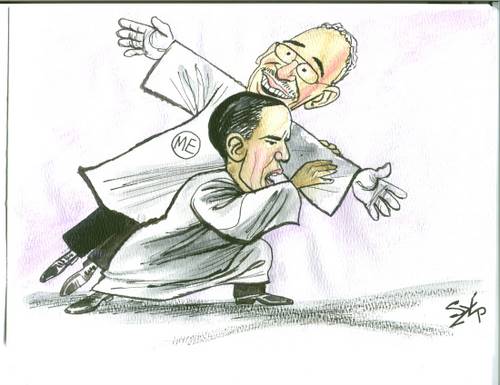
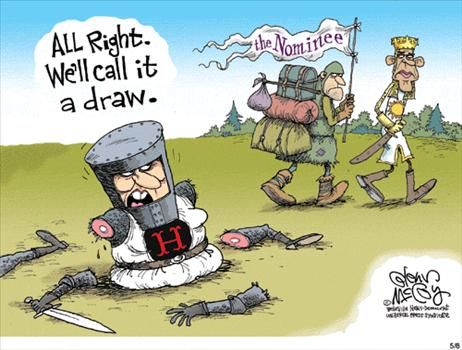
This is to lighten up the mood for the United States' 2008 Presidential Elections. Sometimes things can get a little too serious for us to continue watching the news, debates, commercials and speeches. Sometimes we require a good healthy laugh to keep us sane. So here for your Sanity are some of the 2008 Presidential Election Political Cartoons that have gotten me to at least smile. From the cartoons explaining Obama's Youth to the Political Cartoon that explores his road runner like endurance we can not only get humorous insight into some of the candidates but inform ourselves in a lively manner. Not to be taken too seriously these Cartoons are here for your enjoyment. In fact I think I will begin to post at least one cartoon with every story to keep things light while the elections get heavy.
How Obama Gets the young, white, X-urb, rebellious vote, while at the same time appealing to the good ole American Entrepreneurial Spirit.
Well at least we know where his work ethic came from.
Sometimes the Wrong Way might just be the right way, but then again which way would be up if the Christian Right Went Away?
And Awaaaaaaaaaay they go! (Our Votes that is.)
Change it's not "whats" in your pocket but "who?"
It seemed to be the Fad last year.


