Wednesday

Obama and McCain: The effect of economy on Polls & Todays Political Cartoon

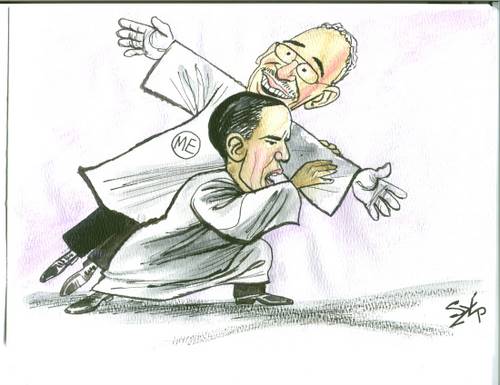
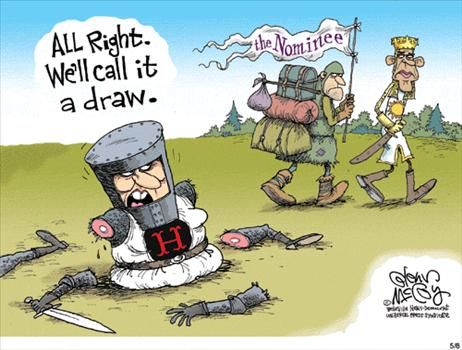
Political Cartoon, Election Cartoon, Obama, PollsSo what do the polls say now? A little less hacker this week and a little more poll talk, things seem to be not so up in the air anymore. I thought that today's political cartoon, though old, was quite fitting. This cartoon is just a portrayal of the polling process and what it does to the candidates. So now let the cartoon be the introduction to the following, almost, report.

With four months to go until Election Day, the outcome is set in stone, barring some sort of miracle, some experts say.

Unfortunately for John McCain's chances, the economy is very weak, and almost everything else is going against him as well, which means Barack Obama will almost certainly be elected president.

That's the view of the overwhelming majority of social scientists who make it their business to peer into the future.

With four months to go until Election Day, the outcome is set in stone, barring some sort of miracle, they say.

The poor state of the economy, the casualties in Iraq, the unpopularity of George W. Bush, the current polling, and Obama's own political skills all point to the election of the Illinois Democrat in November, according to several political scientists, historians and economists who've had a pretty good track record in predicting past elections.

According to their models, it won't be close. Most of them are projecting a 52% to 48% victory for Obama, and that's with assumptions about the economy that are very kind to McCain.

Political scientists noted long ago that presidential elections are fairly predictable because they usually turn on several big issues: How's the economy doing? Is there an unpopular war? Has one party outlived its welcome at 1600 Pennsylvania Avenue? Is one of the candidates a once-in-a-generation leader? Has the current administration done anything outstanding, or scandalous?

Obama it is!

What actually happens during a campaign -- the ads, the debates, the whistle-stop tours, the endorsements and the innuendo - don't really change the basic landscape that will determine who's in and who's out. In most of the models, it doesn't even matter much who the candidates are, any Democrat and Republican would do as well.

Of course, all these models assume that this year's campaign will be pretty much like those in the past. A major gaffe or stumble by Obama, or superb campaign by McCain could change the dynamics. So could outside events that alter the election landscape.

There's a whole cottage industry of experts who develop statistical models based on past elections and crunch the numbers to try to predict November's vote now. Almost all of the models say Obama will win.

This election could challenge the models' accuracy, for several reasons.
It's unclear how much Obama's race will influence voters; we've never had an African-American as a major candidate before.

And, for the first time since 1952, no incumbent president or vice president is running. McCain could expose flaws in the models if he's able to distance himself from Bush enough. Most of the models assume that the voters will reward or punish the incumbent party candidate in line with how the incumbent has performed.
And What the Models Are Saying

By Lichtman's reckoning, seven of the 13 keys are leaning against McCain, and that doesn't even count on Obama being considered charismatic, or on the economy falling into a recession this year. Since polls show the vast majority of voters think the economy is in a recession, we ought to hand Obama that key as well. Perceptions matter more than the technical declaration of a recession.

Yale economist Ray Fair has been at this game a long time too. His model is based on three economic variables, and now predicts McCain will get 48% of the votes. Fair's model had done a good job through the 1988 election, but has drifted further from the actual results in recent contests. You can plug in your own assumptions about the economy and make your own predictions on Fair's website.

The granddaddy of the prediction models is American University historian Allan Lichtman's 13 keys to the White House, which include factors such as the economy, foreign policy, scandals, social unrest and even the charisma of the candidates. No one's been elected president since 1860 without holding most of the keys to victory.

Economist Douglas Hibbs expanded on Fair's idea by including a war variable, which hurts the incumbent party if there are significant casualties in an undeclared war. Hibbs' "Bread and Peace" model explains Eisenhower's victory in 1952 and Nixon's win in 1968. The unpopular war could also be a factor in 2008, but the weak economy is a much bigger reason why the Republicans are likely to get just 48% of the votes this year.

"Support for the two major parties has solidified as the parties and their supporters have become increasingly divided along ideological lines," Abramowitz said. "Growing polarization may weaken the effects of short-term forces such as the economy and presidential approval." The approval rating of the president is one of three variables in Abramowitz's model.

Political scientist Alan Abramowitz of Emory University says his "Time for a Change" model is forecasting a Democratic landslide of about 54% to 46%. But Abramowitz doesn't think it'll be that much of a blowout because there are fewer true independents these days.

Sunday

Political Cartoons for your Pleasure

Political Cartoon, Obama
Political Cartoon, McCain
Political Cartoon, Iraq, McCain
Political Cartoon, Obama, Wright
Political Cartoon, Flag Pins
Political Cartoon, Obama, Clinton

Electronic Voting---How Safe are the 2008 Elections Going to Really Be?

Political Cartoon, Electronic Voting, 2008 Elections


The following article is a good example of what we face in the future of elections as we steadily move towards electronic voting during our elections. Beyond the chances of these machines being compromised by politicians and their circle of friends we also face problems regarding the software of the machines themselves. As many companies continue to insist that it would be impossible to compromise a machine during an election this article goes to show that an Obama v. McCain election could very well be compromised with the use of electronic voting. I will be the first to admit that something like the following is not the easiest of things to do and that we most likely will not face a plague of hacked voting machines but a couple machines in a couple of key counties in a couple of key states could prove to be more than enough as elections are becoming tighter and tighter races. Also I think it is a fair assumption to think that if voter fraud were to become a major problem during a presidential election that this election would be a large target. With a black presidential nominee with possibly a female vice president, if he so chooses, and a republican nominee who currently is slightly lagging in polls and has issues with the public because of his close ties to the current president, many organizations may find that their only hope of winning is to tamper with a voting machine. Now I know that voter fraud has existed for years and that to think that elections are completely and 100% free of any tampering is naive and irresponsible, but with the advent of electronic voting the tactics used become harder to trace, harder to prove, harder to fix, and easier to do. Please read the following article with a lens that will shed insight into the possibilities of our upcoming election. Then ask yourself; What can we do about this?, Is electronic voting really worth the risk of implementation?, is there a better way to improve the voting procedure?

What it Means to Be A Hacker:

My most recent confrontation with what it means to be a hacker started in March of 2006, after I went to vote for the local council of Amsterdam. At the polling station, I had to use a brand-new electronic voting machine that the city was renting from a company called Sdu. In fact, Amsterdam had contracted the entire election as a turnkey service, Sdu was even training the poll-workers. This "voting machine" was in fact a computer with a touch screen running Windows. To make maters worse: inside each computer was a GPRS wireless modem that sent the election results to Sdu, which in turn told the city. I had not been blind to the problems of electronic voting before, but now I was having my face rubbed in it, and it hurt.

Perhaps I should quickly introduce myself. My name is Rop Gonggrijp and I'm a dutch national that lives in Amsterdam, The Netherlands. Some of you will know me as I have been mentioned in this magazine as well as been a regular guest on Off the Hook for almost as long as the show exists. I'm one of the main organizers for these Dutch hacker events. Between 1989 and 1993 I published Hack-Tic, a magazine not unlike 2600 except that it was written in Dutch. During the late Hack- Tic years I co-founded XS4ALL, which still is one of the larger ISPs in The Netherlands.

I guess I became part of the hacker community sometime during the early 1980s while playing with my fathers 300 baud acoustic modem, although arguably I was hacking before when I was soldering FM- transmitters together with a friend at age 12. But after reading Steven Levy's book 'Hackers, heroes of the computer revolution', I knew what I was and that I was to be part of a global community, even if I could only knew a few other hackers around me.

Imagine my relief when I went to Hamburg for the 1988 Chaos Communication Congress to find a few hundred other hackers. After that I was hooked, and by 1989 I was one of the organizers of the first European hacker event: the Galactic Hacker Party. Long and formative years of exploration, mayhem and mischief followed, during which, among many other things, we found and shared many new and interesting ways of making free phone calls.

And when we got our hands on the keys to the nuclear bunkers that underlied some subway stations in Amsterdam, we promptly organized tours there for all our friends and their friends. But even behind the greatest mischief was the motivation to educate, to sharpen the minds of fellow hackers and of the population at large.

XS4ALL, the Internet provider, was much more a political statement than anything else. The Internet back then would never make any money: way too difficult and freaky for the general population. I left XS4ALL in 1997 and started a computer security consultancy, and then after that a company that builds voice encrypting mobile phones, but I kept going to hacker events and co-organizing our own event every four years.

Fast forward to 2006 and the local elections. I was angry because I felt my election had been stolen: there was no way to observe a count, one just had to believe that this wireless-equipped black-box Windows machine was counting honestly. I knew a little bit too much about the risks associated with computer technology to go along with that. I wasn't the only one that was angry: my longtime friend Barry came home from that March 2006 election with the exact same story that I had come home with: trying to reason with poll-workers that clearly felt that only the medically paranoid would distrust such a wonderful shiny box. When we met later that day we vowed to not only get mad, but to do something about it.

Which wasn't going to be all that easy. By the time Amsterdam had gotten electronic voting, it was pretty late in the game: Amsterdam (pop. ~750k) was the last city in The Netherlands (pop. 16.5M) to get electronic voting. Some cities were renting the same system as Amsterdam, but the vast majority was using an older system made by a company called Nedap. While I studied the legal requirements for electronic voting, I became even more convinced that all of these 'machines' (that were all in fact computers) needed to go if we were to have transparent and verifiable elections.

The regulations treated these systems as if they were indeed mere 'machines': they worried about the amounts of humidity and vibration they could withstand and they made sure nobody would get shocked from touching one. Computer security wasn't even mentioned. But the biggest problem wasn't the lack of security, it was the lack of transparency. We got together a small group of like-minded people and started planning a campaign.

There had been previous attempts to raise the question trustworthiness in relation to voting machines, but the ministry of the interior was used to painting the opponents of electronic voting as technophobe luddites. Given that half our group consisted of hi-tech-loving hackers this was an approach that wasn't going to work this time.

During the next year and a half we managed to get the attention of the media. (((Believe it or not, this has always been a hacker specialty.)))

We claimed that the Nedap 'machines' were computers and not 'dedicated hardware' (as the manufacturer claimed) and that they could just as easily be taught to play chess or lie about election results. The person selling these computers in the Netherlands wrote wonderful long rants on his website, and in reaction to our claim he said he did not believe his 'machines' could play chess.

So we caused a true media frenzy when we got hold of a Nedap voting computer and made it play chess. (We also made it lie about election results.) There was a debate in parliament, during which the responsible minister promised to appoint two committees. That next election, an international election observation mission studied the problems with electronic voting in the country which until then had always been the example country for uncontroversial e-Voting. In their report, they advised that this type of voting computers "should be phased out" and the two committees also wrote very harsh reports about how these 'machines' came about and how they should not be used in the future.

A lot more happened: we threatened to take the government to court on several occasions, and we even won a case in which the Nedap approval was nullified. But by then the ministry had already decided to throw in the towel, retracting the legislation that allows electronic voting. The next elections in The Netherlands will be held using pencils and paper. (Which is really quite OK since over here we've only got one race per election, so counting by hand isn't all that hard.)

One of the things that struck me about this campaign is that in order to win, we've needed almost every hacker-skill imaginable. (((The converse to this interesting statement is that there isn't a single political skill which can't be hackerized.)))

Imagine all the stuff you can learn from this magazine, or from going to (or helping organize) a hacker convention. From general skills such as dealing with the media or writing press-releases to social engineering (getting hold of the system), lockpicking (showing the mechanical locks were bogus, the same 1 Euro key was used all over the country), reverse engineering (modifying their 68000 code without access to source) and system administration (website). Having published a hacker magazine and done the ISP, I was no stranger to conflict: at XS4ALL we had had serious issues with the infamous 'church' of Scientology as well as with the German government. Also the international contacts I got from growing up in the hacker community paid off: the hack was very much a Dutch-German project, and we're still working together tightly to also get rid of these same 'machines' in Germany. At certain moments I had the funny feeling that somehow this was the project that I had been in training for all these years.

So I guess what I'm saying is that if you are a hacker, if you're going to hacker conventions, if you like figuring stuff out or if you are building your own projects.... Please realize that, possibly by accident, you may also possess some truly powerful skills that can help bring about political change, and that these skills will become more and more important as technology becomes a bigger part of ever more political debates. So if you don't like the news: go out and make some of your own!

(This Article was taken from the 2600 Magazine and written by Rop Gonggrijp)


Saturday

Obama Polls: Election 08 Obama v McCain

Political Cartoon, Voting, Election 2008
For the Political Cartoon of the Day I think it appropriate to go with the following cartoon which deals with the concept of electronic voting in the upcoming election. After today I am going to start dealing with some of the issues surrounding the election itself instead of just the candidates. I think this political cartoon shows what is at the heart of the election but by the voting population is not paid really any attention. Soon I will get back discussing the politicians and their ideals and ideas but for now I will just discuss the current issue of polls surrounding the candidates and how we are getting a little carried away and then the Electronic Voting Issues for a few Days. I will also be doing a post or two of just some funny and interesting Political Cartoons and Videos of the 2008 Elections. Today though we are just going to deal with the overwhelming number of polls and what exactly to they really mean?

“It’s increasingly clear from our ‘poll of polls’ average that Sen. Obama holds a small advantage over Sen. McCain as we head into the general election,” says CNN Senior Political Researcher Alan Silverleib. “Time will tell whether Obama's lead is a temporary bounce resulting from the end of the Democratic nomination fight, or whether it is a more permanent reflection of voters’ desire for change this year.”

The latest edition of the CNN Poll of Polls is an average of four new national surveys, a Gallup poll taken from June 9-12, an NBC/Wall Street Journal survey conducted from June 6-9, a Diageo/Hotline poll taken from June 5-8, and our own CNN/Opinion Research Corporation survey conducted from June 4-5. The CNN Poll of Polls does not have a sampling error. Which in my opinion is kind of hard to understand considering my stats background.

Presumptive Democratic nominee Obama holds a six point lead over his Republican counterpart McCain a new CBS News poll finds. Obama leads McCain 48 percent to 42 percent among registered voters, with 6 percent of respondents undecided.

The poll contains troubling signs for Obama as he looks to mobilize the Democratic Party behind him following his long and sometimes bitter battle with Hillary Clinton for the Democratic nomination, however.

So what polls are to be trusted? We know that with the White Male vote McCaine leads Obama by double digits and is also ahead of Obama in the Suburban Moms demographic while Obama leads in the Lation, Young Voters, and overall Women Demographic. All of this information leads to inconclusive evidence seemingly pointing us to the conclusion that as of yet we have not decided what we want as a country. We also know that 68% of all previous Clinton voters are saying they will vote Obama in the upcoming election while nearly 10 % are undecided and the rest say they will vote for McCain.

Twelve percent of Democrats say they will support McCain in the general election. That's higher than the 8 percent of Democrats who defected to President Bush in 2004. Nearly a quarter of Clinton supporters say they will back McCain instead of Obama in the general election.

McCain leads Obama by 8 points among registered independent voters, considered a key voting block in November. The Arizona senator leads Obama 46 percent to 38 percent, with 11 percent of respondents undecided.

And overall we know that the margin of error in a complete poll still overlaps leading to a direct tie between the two candidates in terms of the upcoming election. This year seems to show though that we are beginning to try a predict a little too much when we really don't have the information necessary to make any kind of informed decision, we still have not heard the two in a head to head debate with a widely publicized and distribution model and we still do not know at what point the two candidates are going to pick their running mates. Although many voters feel that the running mate does not bear too much weight on their decision for president I think that this year we could see a large change in that viewpoint if Obama were to pick Hillary as a running mate or McCain to pick another female as well. I also think it is quite plausible that McCain could pick somebody from the state of Alaska as his running mate for reasons of shared interest with the Bush Administration in terms of drilling, ecspecially with the rising price of gasoline in this country.

Friday

Clinton caught in Lie about Sniper in Bosnia and Political Cartoon of the Day

Todays political cartoon is a reminder of what Barack and Hillary's strategy should be in pursuing the Whitehouse. This cartoon emphasis the important aspect of the current political climate for the Democrats. Quit attacking each other and continue reminding the public of what the real problem is, not what our pastors say or who ducked out sniper fire or not. Although that is another pretty funny story in itself. Hillary is just getting old and it is affecting her memory.

Dilating on her extensive experience of foreign affairs, the New York senator told a campaign event last week that she vividly remembered how, with the Balkans still a cauldron of war, she had flown into an airfield under sniper fire. She had had to dash, head-down from the aircraft, she told the spellbound audience, to the safety of waiting cars, and the planned traditional arrival ceremony had been hastily canceled in the mêlée.

It sounded thrilling - like something out of a Tom Clancy novel. The problem was, it probably did come out of a Tom Clancy novel. It was pure fiction.

A good memory is needed once we have lied,” observed Pierre Corneille, the 17th-century French tragedian. He was right. The complexities involved in keeping an untruth plausible and consistent are so tortuous that to be really good at lying demands exceptional recall of what was said when and where.

But Corneille was writing before the age of YouTube. Nowadays, no amount of familiarity with memory's labyrinth will save you when there is downloadable disproof at the click of a mouse button. So Hillary Clinton discovered this week, when she was caught out in a prize fib about a trip she made to Bosnia when she was First Lady 12 years ago.

CBS unearthed some news video of the arrival ceremony and it was promptly disseminated on YouTube. There was Mrs Clinton, serene and smiling, strolling with her entourage from the plane, head held high, and in no evident danger from snipers, terrorists, or even the odd slightly miffed Serb. Seconds later she was being greeted in what looked very much like a traditional arrival ceremony on the tarmac where a small girl embraced her and the two chatted warmly for a while. I've been in more physical danger coming out of the car park at Heathrow.

Confronted with the incontrovertible evidence Mrs Clinton acknowledged this week that she “misspoke”. Misspeak is an Orwellian term deployed by politicians to describe what has happened when they have been caught in a barefaced lie.

The Clintons have a well-formed habit of misspeaking. Bill Clinton, of course, was always doing it. But his wife has also over the years mastered the art of misspeaking in what Mark Twain once described as an “experienced, industrious, ambitious and often quite picturesque” way.

She has misspoken on any number of occasions when the straight truth might have been very damaging: over her involvement in the various scandals of the early Clinton years. But alongside these instrumental whoppers, there have been some befuddlingly pointless little tiddlers too.

When she ran for New York senator she claimed to have been a lifelong fan of the New York Yankees even though no one could recall her ever having expressed the slightest interest in or knowledge of the baseball team.

For no obvious reason she once claimed her parents named her after Sir Edmund Hillary, even though she was born more than five years before the mountaineer's ascent of Everest, when he was known by almost no one outside New Zealand.

In fact the facility with which the Clintons misspeak is so pronounced that it is quite possible they have genuinely forgotten how to tell the plain truth. There was no real need for Mrs Clinton to make the claim about landing in sniper fire. But the compulsion to embroider, to dissemble and to dissimulate is now so entrenched in the synapses of the Clinton brain that it came to her as naturally as the truth would to a slow-witted innocent.

Someone once noted that the thing about the Clintons is that they will choose a big lie when a small lie will do, and choose a small lie when the truth will do. Most of the time they get away with it. But occasionally, an inconvenient truth, like a blue dress with DNA on it, or some forgotten news footage, shows up and damns them.

With this latest deceit stripped away, there is not much left to Mrs Clinton's disintegrating campaign for the Democratic nomination. It capped a bad week for her, a week that might have signalled the end of her hopes.

With a deft speech that was somewhat lacking in complete honesty itself, Barack Obama last week seemed to have acquitted himself quite well, for now, of the charge of being an associate of a ranting, anti-American black preacher. More important, the collapse last week of efforts to schedule a new vote in Florida and Michigan, two states whose earlier primary votes have been disqualified, was deadly to Mrs Clinton. It is now virtually impossible for her to finish ahead of Mr Obama in the delegate count when the primary season ends in early June.

That really ought to be that. After that final primary in Puerto Rico on June 1, Mr Obama will have won more states, more delegates and more popular votes than Mrs Clinton. How in those circumstances can Mrs Clinton claim a moral case for staying in the race?

Her answer is to persuade the party's super-delegates - top party leaders and elected officials who will have the casting votes - that she is more electable than Mr Obama, and that they would be doing the party a favour if they chose her over the wishes of the tens of millions of people who have voted in the primaries.

They are unlikely to be taken in. They are more likely to view it as another example of Senator Clinton's misspeaking. forgot bosnia forgot bosnia forgot bosnia forgot bosnia lie sniper lie sniper lie sniper lie
The Bosnia misspeak, unnecessary as it was, revealed much, however. It helped to expose a much bigger untruth Mrs Clinton has been peddling throughout the Democratic primary campaign - that her time in the White House means she has the necessary foreign policy experience to be president. forgot bosnia forgot bosnia forgot bosnia forgot bosnia lie sniper lie sniper lie sniper lie

First Ladies don't acquire real foreign policy experience. We know that Mrs Clinton did not, as she claimed, play a large role in the Northern Ireland peace process, that she was not, as she claimed, a key voice in counsels on the Balkans, and that she did not even have security clearance in the White House for the most sensitive of conversations about national security.

So the problem with the ripping yarn about the Bosnia snipers is that it offers hard evidentiary disproof of improbable claims about her role during the White House years.

forgot bosnia forgot bosnia forgot bosnia forgot bosnia lie sniper lie sniper lie sniper lie political cartoon is something we need to laugh at, because a political cartoon is funny as hell. Who doesn't like a political cartoon because political cartoon s are what makes things easier for us to deal with politically. The political cartoon is also a nice reminder of current events and a political cartoon makes certain topics relavent to people who would normally not pay attention